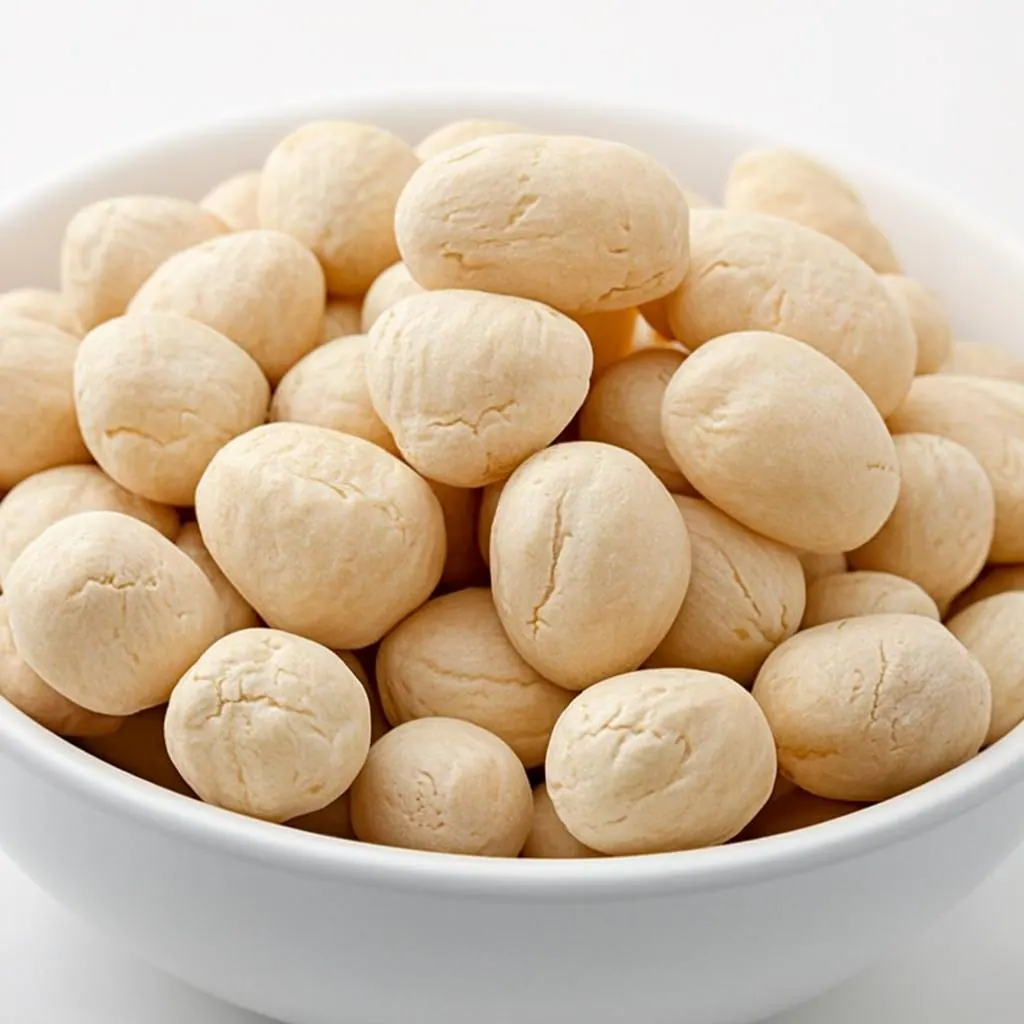
Blanching is mechanical skin removal. The kernel is warmed enough to shrink and loosen the testa, then rubbed between rollers or brushes until the skin comes away, then separated from the skin fragments by air. That is the whole process. It is not a wash, it involves no chemical, and it does nothing at all to aflatoxin, which is a point worth being blunt about because it is a genuine misconception in the trade.
What changes when the skin comes off is almost everything else. The kernel looks different, keeps for a shorter time, breaks more easily, and behaves differently in a fryer and in a grinder. So a blanched specification is not a skin-on specification with one line added. Three parameters move to the front: skin removal percentage, split percentage, and the oxidation pair of free fatty acid and peroxide value.
The two numbers that fight each other
Skin removal percentage is the proportion of the lot with the testa fully off. Split percentage is the proportion broken into halves or fragments. These are not independent. The last stretch of skin removal is achieved by working the kernel harder, and working the kernel harder breaks it.
| Skin removal | Typical split consequence | Suits |
|---|---|---|
| 96% to 97% | 2% to 3% splits | Grinding, paste, butter, where residual skin specks are tolerable |
| 98% | 3% to 5% splits | The common commercial standard for coated and salted snacks |
| 99% and above | 6% and upward, or a second sort at extra cost | Retail whole-kernel presentation, light-coloured coatings |
The practical instruction follows from the table. Do not specify skin removal in isolation. A purchase order asking for 99.5 percent skin removal and 2 percent maximum splits is asking for something a roller line does not do, and what you will receive is one of the two, chosen by the supplier rather than by you. Say which one governs.
If you are grinding, say so, and buy 96 to 97 percent removal with a loose split tolerance. You are about to destroy the kernel anyway, and paying for whole-kernel integrity you will not use is the classic overspend here. The same logic applies to count: as covered in the peanut grades guide, count decides appearance, and appearance stops mattering the moment the kernel enters a grinder.
Why blanched kernels go stale faster
The testa carries a meaningful share of the kernel's natural antioxidants. Remove it and you have removed part of the protection against oxidation of the kernel's own oil, which is what staleness is. The kernel has not become fragile in some vague way, it has lost a specific defence.
That makes two laboratory numbers worth contracting.
- Free fatty acid, expressed as a percentage on the oil basis, rises as the oil hydrolyses. A low figure at dispatch is your headroom. Contract 1 percent maximum and treat a lot arriving at 1.8 percent as a lot with much of its shelf life already spent, even though it is still edible and still passes most other lines.
- Peroxide value, in milliequivalents of active oxygen per kilogram, measures oxidation that has already occurred. It is the more direct rancidity indicator and it is the one buyers most often forget to ask for.
Packing then decides how fast those numbers move after dispatch. Vacuum packing in 25 or 30 kg blocks is materially better than a woven bag for blanched product, and it is worth the cost difference on anything with a long onward storage life. Nitrogen flushing goes further again. Whether that is justified depends on your turn rate, not on the supplier's preference.
Appearance is the reason you bought it, so specify it
Blanched kernels are bought because they are pale, uniform and clean-looking. That is a real functional benefit, not vanity: in a coated snack the coating colour reads truer over a pale kernel, and in a paste the absence of skin fragments removes the dark specks that consumers read as burnt.
So write the appearance parameters down.
| Parameter | What to state | Why |
|---|---|---|
| Colour uniformity | Against a retained sample, not a word | "Uniform cream" means nothing enforceable. A sealed retained sample does. |
| Scorched kernels | Maximum percentage | The heat step before rolling can over-treat. Scorched kernels are the visible evidence. |
| Residual skin | Maximum percentage of kernels with visible skin | This is the enforceable form of skin removal percentage. |
| Discoloured kernels | Maximum percentage | Correlates with mould history, so it doubles as a risk indicator. |
| Splits and broken | Separate maxima | Halves and fragments behave differently on a coating line. |
| Foreign matter | Maximum percentage | Skin fragments count as foreign matter here and are the usual finding. |
A retained sample sealed by both parties at contract, one copy held at origin and one at destination, resolves more appearance disputes than any adjective. It costs almost nothing and it is the single most useful thing you can add to a blanched peanut contract.
Blanching makes defects visible, which cuts both ways
Take the skin off and a bruised, mouldy or immature kernel stops hiding. This is genuinely useful. A colour sorter working on blanched kernels is far more effective than the same sorter working on skin-on kernels, because the contrast between a sound pale kernel and a discoloured one is much larger than the contrast between two brown testas. If your lot is going to be optically sorted, having it blanched first improves the sort.
The uncomfortable corollary is that blanching a marginal raw lot produces a visibly marginal blanched lot. Suppliers know this, which is why blanching lines are fed from better raw stock. It also means you should ask about the raw material behind a blanched lot in the same terms you would ask about a skin-on lot: type, count, crop year, moisture at intake, and whether an optical sort was applied before or after blanching. Before and after is better than either alone.
Aflatoxin, stated plainly
Blanching does not reduce aflatoxin. The toxin is produced by fungi that grow in and on the kernel and it is present in the kernel tissue, not confined to the skin.
What blanching does is improve the effectiveness of the step that genuinely reduces aflatoxin, which is removing the kernels that carry it. High-toxin kernels are disproportionately the discoloured, shrivelled, damaged and immature ones, and those are easier to identify and eject once the skin is off. So a line that blanches and then colour sorts and then gravity separates is doing real risk reduction, while a line that blanches and calls it a treatment is not.
The limits themselves depend on destination and on declared intended use, and the European Union applies a tighter maximum level to groundnuts placed on the market for direct human consumption than to groundnuts going for sorting or further physical treatment. Current figures are in Regulation (EU) 2023/915. The sampling behaviour, which matters more than the analytical method, is worked through in the article on aflatoxin limits in the EU, US and India.
One contractual detail that trips buyers up: because the intended-use distinction is a legal one, a lot bought against the looser processing limit cannot simply be repacked for retail after arrival. Decide the intended use before the order, not after the container lands.
Where blanched peanuts actually go
- Peanut butter and paste. The dominant use. Skin fragments would show as dark specks and slightly bitter notes, so blanched is effectively mandatory. Split tolerance is irrelevant here.
- Coated and salted snacks. The pale surface takes coating evenly and colours predictably in the fryer. Whole kernel integrity matters, so this is where 98 percent removal with a tight split limit earns its premium.
- Confectionery and bakery inclusions. Chopped and slivered forms start from blanched kernels. Uniform starting size gives uniform chop, which is where TJ types are preferred for their consistency.
- Chikki, brittle and praline. Sugar work shows every defect, so appearance parameters do the work here.
- Beverage and plant-protein bases. Skin removal is required for colour and for mouthfeel, and free fatty acid limits tend to be tighter than in snack applications.
Packing, storage and loading
| Format | Typical size | When to choose it |
|---|---|---|
| Vacuum block | 25 kg, 30 kg | Default for blanched. Slows oxidation and protects against insect ingress. |
| Nitrogen-flushed bag in box | 10 kg, 12.5 kg, 25 kg | Long onward storage, or a buyer without fast turn |
| Laminated PP woven bag | 25 kg, 50 kg | Cost-driven, short transit, immediate processing on arrival |
| Carton with liner | 10 kg, 12.5 kg | Retail-adjacent, and where handling damage to splits is a concern |
Blanched kernels are slightly denser than skin-on kernels of the same count because the skin is bulk without much weight, so a container loads a little heavier. It still fills on weight rather than volume in 25 and 50 kg formats. Kraft paper lining and desiccant remain worth the cost for the same reason they are on any groundnut container, and the reasoning is in the container loading guide.
Store at the coolest temperature your warehouse allows and away from anything aromatic. Blanched kernels pick up odours readily now that the testa is gone, and a pallet stored next to spices will tell you so.
How we supply it
We ship blanched peanuts against a stated skin removal and split pair rather than a single headline number, with free fatty acid and peroxide value on every certificate of analysis and the raw kernel's crop year recorded alongside. Where a buyer is grinding, we will say so and quote the looser, cheaper specification instead of the retail one.
For skin-on alternatives, the bold, java and red skin grades are described alongside their counts, and the peanut grades guide explains how to read them.