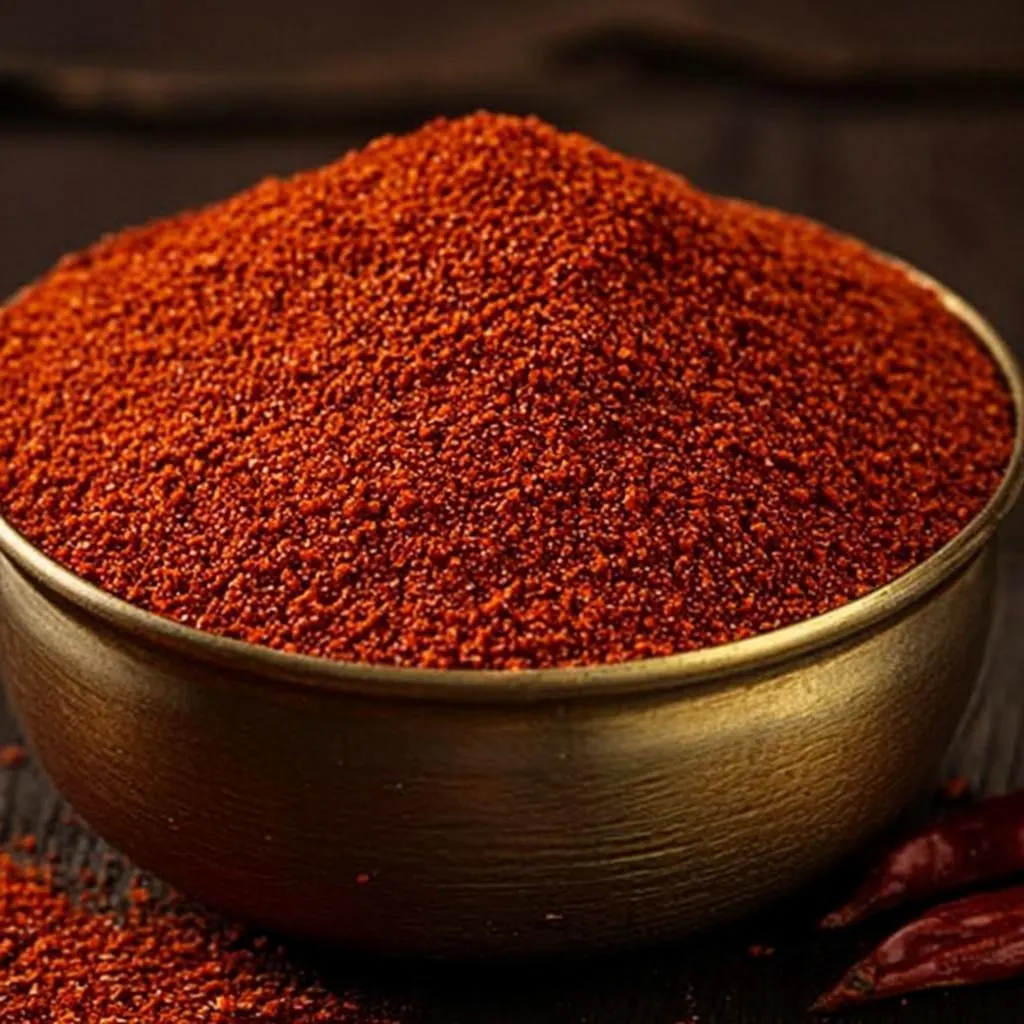
ASTA colour value measures how much extractable red pigment is in a chilli sample. That is all it measures. It says nothing about heat, nothing about aroma, and nothing about cleanliness. Buyers who read a high ASTA figure as "good chilli" and a low one as "poor chilli" are misreading the number in a way that costs money in both directions: overpaying for colour in a product where heat does the work, and under-buying colour in a product that will be judged on appearance in a jar.
The method behind the number is worth knowing because it explains the number's behaviour. A ground sample is extracted in acetone, and the absorbance of that extract is read on a spectrophotometer at a fixed wavelength in the region where the red carotenoids absorb. The reading is converted to ASTA units against a calibration. The whole measurement is therefore a pigment concentration, and pigment concentration is a property that falls over time.
The Indian range, with real numbers
The Spices Board of India publishes ASTA colour values and capsaicin content by variety in its own chilli catalogue. These are the most useful figures available for orientation because they come from the regulator's publication rather than from a seller's brochure.
| Variety | Growing region | ASTA colour value | Capsaicin | Harvest |
|---|---|---|---|---|
| Byadagi, Kaddi | Dharwar, Karnataka | 159.9 | Negligible | January to May |
| Ellachipur Sannam S4 | Amaravathi, Maharashtra | 70.40 | 0.2% | September to December |
| Kashmir chilli | Himachal Pradesh, Jammu and Kashmir | 54.10 | 0.325% | November to February |
| Birds eye, Dhani | Mizoram, Manipur | 41.7 | 0.589% | October to December |
| Hindpur S7 | Hindpur, Andhra Pradesh | 33.00 | 0.24% | December to March |
| Guntur Sannam S4 | Guntur, Warangal, Khammam | 32.11 | 0.226% | December to May |
| Kanthari, white | Kerala, Tamil Nadu | 2.96 | 0.504% | Year round |
Read the first and last rows together. Byadagi delivers 159.9 ASTA with essentially no heat. Kanthari delivers 0.504 percent capsaicin with 2.96 ASTA, which is under two percent of Byadagi's colour. Colour and heat are not merely imperfectly correlated in Indian chilli, they are close to orthogonal, and a specification that names only one of them has left the other entirely to the supplier.
Converting capsaicin to Scoville, and why the conversion is approximate
Scoville Heat Units began as a sensory method: dilute an extract until a trained panel could no longer detect heat, and report the dilution. Nobody measures that way commercially now. Modern testing quantifies the capsaicinoids by chromatography and reports them in parts per million or as a percentage, and the Scoville figure is a conversion.
The factor used in the trade is roughly 16 Scoville units per part per million of capsaicinoids. That makes the arithmetic something you can do yourself:
- Guntur Sannam S4 at 0.226 percent capsaicin is 2,260 ppm, which converts to about 36,000 SHU.
- Birds eye at 0.589 percent is 5,890 ppm, or about 94,000 SHU.
- Kashmir chilli at 0.325 percent is 3,250 ppm, or about 52,000 SHU.
Those results line up with the pungency bands these varieties are known for in the trade, which is a reasonable check that the conversion is being applied sensibly. Two caveats belong with it. The factor is a convention rather than a physical constant, and different capsaicinoids contribute differently to perceived heat, so treat the Scoville number as a communication device and contract the capsaicinoid figure in ppm if the value matters commercially. And a total capsaicinoid figure is a mixture, so two lots at the same ppm can taste subtly different in onset and duration.
Colour value decays, so a figure without a date means little
This is the most common practical failure in chilli buying. A certificate says 80 ASTA. The lot arrives, the buyer's laboratory reads 68, and a dispute starts in which both parties are telling the truth.
Carotenoids degrade with heat, light and oxygen, and every step of handling accelerates it.
| Factor | Effect on colour value | Practical control |
|---|---|---|
| Time | Steady decline from harvest onwards | Contract crop year, and test at a named point |
| Grinding | Sharp acceleration, surface area rises enormously | Buy whole and grind late, or accept a faster decay curve |
| Temperature | Faster loss in a warm warehouse | Ambient control at destination, not just in transit |
| Light | Faster loss in transparent packaging | Opaque or foil-laminate packs for powder |
| Oxygen | Faster loss with headspace | Vacuum, nitrogen flush, or tight fill |
| Moisture | Interacts with the above and adds caking risk | Contract moisture and control it, usually 10% to 11% maximum |
The contractual answer is to name the measurement point. "80 ASTA minimum, tested at load port on a sample drawn by the nominated surveyor" is enforceable. "80 ASTA" alone is an argument waiting to happen, because it implicitly claims a permanent property that pigment does not have.
If your product is judged on colour at the shelf rather than at the port, the useful move is to build the decay into the purchase. Buy above your target, define the tested-at-load figure, and separately record what you measure on arrival so that after two or three shipments you have your own decay curve for your own supply chain. That curve is worth more than any supplier's assurance.
Whole chilli holds colour considerably better than powder for the surface-area reason, which is why buyers with the capability increasingly import whole or lightly crushed product and grind close to use. It also removes an adulteration surface, since powder is far easier to dilute or dye than a whole pod.
What else belongs in a chilli specification
Colour and pungency get the attention. These are the lines that decide whether a container clears.
- Moisture, usually 10 to 11 percent maximum. Above that you have mould risk over a sea leg and caking risk in powder.
- Total ash and acid insoluble ash. Total ash reflects mineral content, acid insoluble ash reflects sand and soil. The second is the one that catches poor cleaning, and the same reasoning applies as in the cumin grades article.
- Stems and calyx. For stemless grades this is the defining line. Stems dilute colour, add fibre and reduce yield in extraction.
- Broken, damaged and discoloured pods. Discoloured pods pull the colour value down and often indicate a mould history.
- Aflatoxin and ochratoxin A. Chilli is a recognised risk commodity for both. Maximum levels are in Regulation (EU) 2023/915 and the sampling behaviour matters more than the analytical method, as set out in the aflatoxin article.
- Pesticide residues. Chilli is among the Indian commodities most often flagged at EU border control posts. How the residue limits work, including what applies when no specific limit is listed, is covered in the article on EU pesticide MRLs.
- Sudan dyes and other unauthorised colourants. Historically the reason for a large number of EU rejections on chilli products. Any lot bought on colour should be tested for them, precisely because colour is what the adulteration is imitating.
- Microbiology. Total plate count, yeast and mould, Salmonella. This is where the sterilisation question arises, and why steam treatment rather than ethylene oxide is the route for European destinations, as explained in the ethylene oxide article.
- Cleanliness against ASTA-style defect categories. Whole insects, insect fragments, rodent hair, excreta and extraneous matter, each as its own limit. The American Spice Trade Association publishes the framework the trade generally works to.
Buying for extraction versus buying for the table
These are two different businesses using one price list, and they should behave differently.
If you are extracting colour, you are buying ASTA units. The only sensible comparison between two offers is cost per ASTA unit per kilogram, and pungency is often an active negative because it has to be separated or diluted downstream. Byadagi and similar high-colour, low-heat types dominate here for exactly that reason, and paying for a pungent chilli then removing the pungency is pure waste.
If you are selling a table condiment, chilli powder for retail or a curry base, heat is the product attribute and colour only has to be acceptable. Buying 120 ASTA when your consumer cannot distinguish it from 60 ASTA in a finished sauce is money spent on a laboratory number.
Most disputes about "expensive chilli" turn out to be a buyer purchasing against the wrong one of these two logics.
How we supply it
We ship whole dry red chillies, stemless red chillies, crushed red chillies, red chilli flakes and red chilli powder against a named variety with the ASTA value and capsaicinoid content tested at load and dated on the certificate of analysis. Where a buyer is extracting colour we quote cost per ASTA unit rather than cost per tonne, because that is the number that decides the deal.
The variety map, including which types are worth paying for and which are interchangeable, is in the Indian red chilli varieties guide.