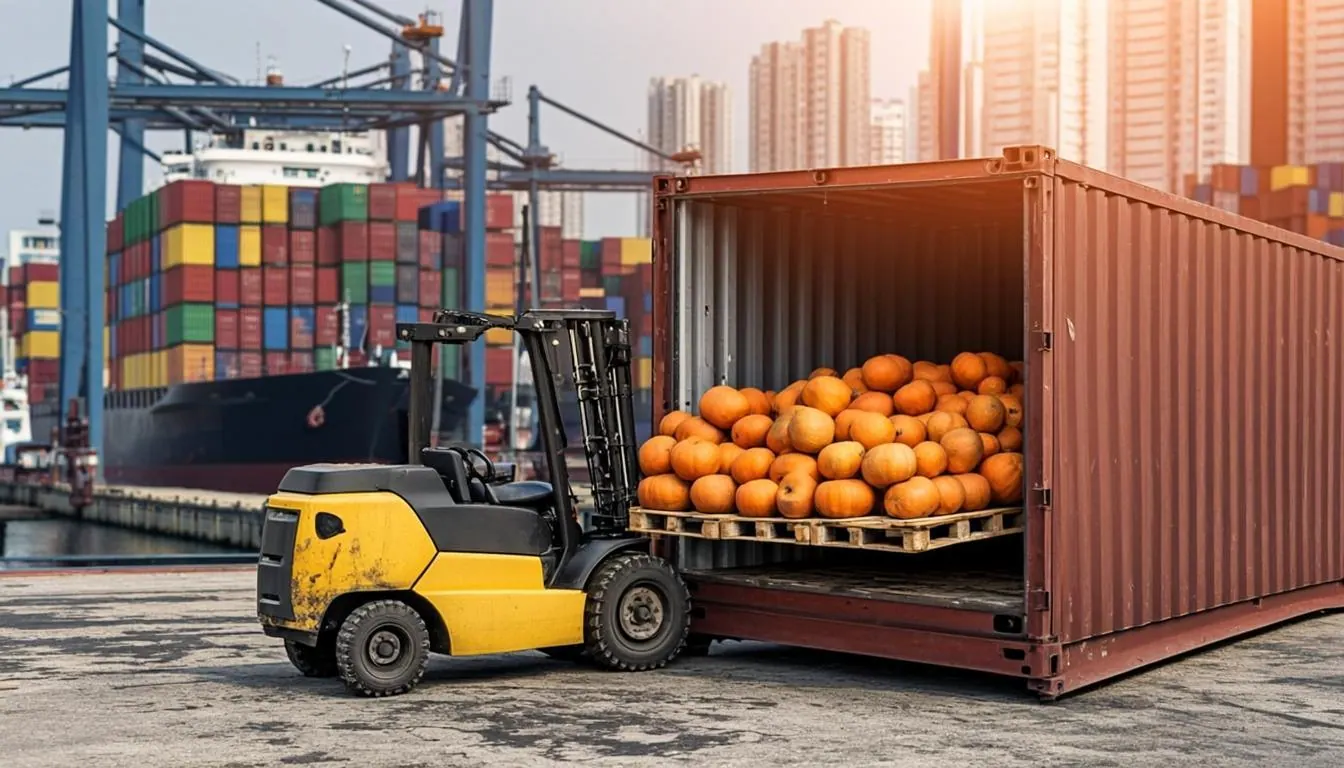
How many tonnes fit in a 20ft container is the most commonly asked question in commodity logistics, and the answer that gets given, "about 26 to 28 tonnes", is right for pulses and wrong for almost everything else. It is wrong for sesame, badly wrong for cumin, and absurdly wrong for makhana.
The useful thing is not the number, it is the method. Once you can work out the answer for yourself, you can plan a landed cost for a commodity you have never shipped, spot a quote where somebody has assumed the wrong box, and stop paying for air. This is that method, plus the specification numbers you need to apply it, plus the physical precautions that keep the cargo in the condition it left in.
Start with the box
Three container types cover almost all dry agricultural cargo. These are typical figures, and the exact numbers for the container you are given are stamped on its CSC plate on the door, so read them rather than trusting a table.
| 20ft general purpose | 40ft general purpose | 40ft high cube | |
|---|---|---|---|
| Internal length | About 5.90 m | About 12.03 m | About 12.03 m |
| Internal width | About 2.35 m | About 2.35 m | About 2.35 m |
| Internal height | About 2.39 m | About 2.39 m | About 2.70 m |
| Internal volume | About 33.2 cbm | About 67.7 cbm | About 76.3 cbm |
| Tare weight | About 2,200 to 2,300 kg | About 3,700 to 3,800 kg | About 3,900 to 4,000 kg |
| Maximum gross weight | Usually 30,480 kg | Usually 30,480 kg | Usually 30,480 kg |
| Payload | About 28,200 kg | About 26,700 kg | About 26,500 kg |
| Door opening width | About 2.34 m | About 2.34 m | About 2.34 m |
Read the payload row again. The 40ft has more than twice the volume of the 20ft and slightly less cargo weight capacity, because the maximum gross weight is the same on both and the 40ft's own steel weighs more. Some trades offer heavy tested 20ft boxes rated above 30,480 kg gross, which raises the payload further. Ask, because if you are shipping something dense it changes your economics.
The break-even density, and why it settles every loading question
Divide the payload by the internal volume and you get the density at which a container runs out of weight and space at exactly the same moment.
| Container | Payload | Internal volume | Break-even density |
|---|---|---|---|
| 20ft general purpose | About 28,200 kg | About 33.2 cbm | About 850 kg/cbm |
| 40ft general purpose | About 26,700 kg | About 67.7 cbm | About 395 kg/cbm |
| 40ft high cube | About 26,500 kg | About 76.3 cbm | About 350 kg/cbm |
The rule that falls out of this is short enough to memorise. If your cargo's as-loaded density is above the break-even figure, the container fills on weight and the extra space is wasted. If it is below, the container fills on volume and the unused payload is wasted. And since the break-even figure for a 20ft is more than twice that of a 40ft high cube:
- Dense cargo goes in a 20ft. Anything above roughly 400 kg per cubic metre is weight limited in a 40ft, so you would pay for a 40ft and receive no more cargo than a 20ft gives you.
- Light cargo goes in a 40ft high cube. Below roughly 350 kg per cubic metre the payload is irrelevant and all you want is volume, which is exactly what the high cube sells.
- Cargo between about 350 and 850 kg per cubic metre is the interesting band, and it needs the arithmetic done rather than a rule of thumb.
As-loaded density, not bulk density
One correction before you start calculating. The density figure you want is not the laboratory bulk density of the loose commodity. It is the effective density of the cargo as it sits in the container, which includes the bag or carton, the voids between packages, the dunnage and the gap you cannot fill at the door.
Bags conform to each other and stack tightly, so bagged cargo typically achieves 90% to 95% of the internal volume. Cartons are rigid and stack in fixed patterns, so they usually manage 80% to 88%. Drums are worse again because of the round cross-section. The numbers below are as-loaded figures for typical bagged or cartoned shipments, which is why they are lower than the bulk densities you will find in a textbook.
| Commodity | As-loaded density | Typical 20ft load | Limited by |
|---|---|---|---|
| Chickpeas and other whole pulses, 50 kg bags | About 780 to 820 kg/cbm | About 26 to 27 MT | Weight and volume together, so effectively both |
| Split pulses and dals, 50 kg bags | About 760 to 800 kg/cbm | About 25 to 26 MT | Weight and volume together |
| Groundnut kernels, 50 kg bags | About 650 to 700 kg/cbm | About 21 to 23 MT | Volume |
| Sesame seed, 25 or 50 kg bags | About 600 to 650 kg/cbm | About 18 to 19 MT | Volume |
| Whole cumin seed, bags | About 480 to 550 kg/cbm | About 14 to 16 MT | Volume |
| Castor oil, 200 kg drums | About 500 kg/cbm effective | About 16 MT in 80 drums | Volume, because of the round drums |
| Castor oil, flexitank | Effectively the oil density | About 20 to 24 MT | Weight |
| Makhana, cartons | About 90 to 110 kg/cbm | About 2.5 to 3 MT | Volume, by a very wide margin |
Two things to notice. Pulses sit almost exactly on the 20ft break-even density, which is why the trade never thinks about the distinction: for pulses the weight limit and the volume limit arrive together. And makhana at around 100 kg per cubic metre is roughly one eighth the density of pulses, which is why its ocean freight per kilogram is several times higher. We work through that case in makhana grades and the suta size system.
Worked examples
Kabuli chickpeas in a 20ft
As-loaded density about 800 kg per cubic metre. Internal volume 33.2 cbm, and bags achieve around 95% of it, so about 31.5 cbm of cargo. That gives 31.5 × 800, which is roughly 25.2 tonnes, or about 520 bags of 50 kg. The payload of 28.2 tonnes is never reached, so this is a volume-limited load that looks weight limited. Adding 25 kg bags instead would improve the fill slightly by reducing void space, at the cost of more handling.
The same chickpeas in a 40ft high cube
Volume is no longer the constraint, so now the payload binds at about 26.5 tonnes. You would pay 40ft freight to move about 1.3 tonnes more than a 20ft carries. This is the mistake to avoid, and it is common when a buyer consolidating several commodities defaults to a 40ft because it sounds efficient.
Makhana in a 40ft high cube
Internal volume 76.3 cbm, cartons achieving about 85%, so about 65 cbm of cargo. At 100 kg per cubic metre that is about 6.5 tonnes against a payload of 26.5 tonnes. You are using a quarter of the weight capacity and paying for the whole box. There is nothing to fix here, it is simply what light cargo costs, but it does mean a first order should probably go as part of a consolidated shipment rather than as a full container.
A mixed container
Mixed loads are where the arithmetic earns its keep. Suppose you want 15 tonnes of chickpeas and some makhana in a 20ft. The chickpeas take 15,000 divided by 800, which is about 18.8 cbm, leaving about 12.7 cbm of the 31.5 usable. At 100 kg per cubic metre that space carries around 1.3 tonnes of makhana, and the total weight is 16.3 tonnes against a 28.2 tonne payload. The box is full and the weight limit is nowhere in sight. Load the dense cargo on the floor and the light cargo on top, and use dunnage bags to stop the top layer shifting into the void that opens up as the bags settle.
The limit that is usually not the container
A container rated for 28.2 tonnes of cargo is only useful if the road leg at each end can legally carry it. Road and axle weight limits are set nationally, they vary widely, and they are frequently the binding constraint on how much you can actually put in the box.
You do not need a table of every country's limits. You need to ask two questions before you fix the tonnage:
- What is the maximum cargo weight my haulier at the destination can legally and practically take on a single container move, and does it change for a 20ft against a 40ft?
- Does the destination port or terminal impose its own limit, and are there any restricted routes or bridges between the port and my warehouse?
The reason this matters commercially is that discovering the answer after arrival means either a transloading operation, which means breaking bulk and rehandling every bag, or a special permit, or both. Either way you pay, and the cost per tonne on that one container can wipe out the margin on the order. Ask before you load, not after.
Related and mandatory: the verified gross mass declaration. Under the SOLAS convention the packed container's gross mass must be verified and declared to the carrier before it can be loaded on the vessel, either by weighing the packed container or by a certified calculation method. There is no discretion in this and no loading without it, so treat the VGM cut-off as a hard deadline in the same class as the documentation cut-off.
Container rain, and why lining is not optional
This is the physical failure that damages more agricultural cargo than rough handling does, and the mechanism is worth understanding rather than just following the instruction.
Your cargo carries moisture. Sesame at 5%, chickpeas at 11%, cumin at 8%. Some of that water is in equilibrium with the air inside the sealed container. When the container is loaded in Kutch in May and then crosses into a North Atlantic winter, the steel roof and walls cool far faster than the cargo mass inside. The air in contact with that cold steel drops below its dew point, the water it was holding condenses on the ceiling, and eventually it falls on the top layer of bags. That is container rain, sometimes called container sweat.
The related version is cargo sweat, where warm moist air condenses on cargo that is colder than the air, which happens on the reverse route. Either way the damage looks identical from the outside: wet patches on the top or outer bags, then mould, then a claim, and for a commodity with a mycotoxin risk it can also mean a compliance failure on arrival rather than just a cosmetic loss.
What actually works, in order of importance:
- Ship the cargo dry. Every percentage point of moisture you avoid loading is water that cannot condense. This is why the moisture specification and the loading precautions are the same conversation.
- Line the container. Kraft paper on the walls and ceiling, and on the floor. It intercepts condensation before it reaches the bags and it is inexpensive.
- Use desiccant. Calcium chloride based container desiccant bags hung from the lashing rings, in the quantity the manufacturer specifies for the cargo weight and voyage length. Not silica gel sachets, which are sized for a shoebox rather than a container.
- Inspect the container before loading. Stand inside with the doors closed and look for pinholes of daylight, then check the floor for stains and previous cargo residue and the door gaskets for damage. Reject the box if it fails. This takes five minutes and it is the highest return activity in the whole loading process.
- Do not use ventilation as a substitute. Ventilated containers help with some cargoes and can make condensation worse with others, depending on the humidity of the outside air. Do not switch to them without advice for your specific route and commodity.
- Leave a small air gap at the ceiling and avoid pressing bags hard against the walls, so that any condensation that does form has somewhere to run other than into the cargo.
Stacking, weight distribution and dunnage
How you arrange the load matters for three separate reasons: the cargo has to survive the voyage, the container has to be roadworthy at both ends, and you have to be able to prove what you loaded.
- Distribute the weight evenly along the length. A 20ft loaded to 26 tonnes with the mass concentrated in one half will overload an axle on the road leg even though the total is legal. Spread it.
- Do not concentrate a point load. The container floor has a distributed load rating. Jumbo bags and drums put weight through small footprints, so spread them across the floor area rather than clustering.
- Bond the stack. Alternate bag orientation between layers so the stack ties itself together instead of forming vertical columns that collapse when the vessel rolls.
- Fill the void at the door. As bags settle during the voyage, a stack that was tight at loading develops a gap, and then the front face falls into it. Dunnage bags, or a plywood bulkhead across the door, prevent the whole face collapsing onto whoever opens the doors.
- Protect against the door sill. Do not let bags press against the doors themselves.
- Count and record as you load. Bag count, lot numbers by position if you have more than one lot, and the seal number.
Sealing and photographs
Fit a bolt seal conforming to the ISO 17712 high security standard, record the number, and put that number on the packing list and the bill of lading. A seal number that appears on the documents and matches the seal at destination is the simplest possible answer to a claim that the container was tampered with.
Take photographs at defined stages and keep them with the shipment file: the empty container interior with the doors closed showing no light leaks, the CSC plate, the lining in place, the load at one third, two thirds and complete, the dunnage or bulkhead at the door, and the fitted seal with its number legible. When a dispute happens six weeks later, this set of photographs is worth more than any amount of assertion, and it costs nothing to produce.
Fumigation timing, because it changes your schedule
Where the destination requires fumigation, the treatment needs an exposure period, typically measured in days rather than hours, and it has to happen at the right point in the sequence. In-container fumigation after loading means the container sits sealed for the exposure period before it can be gated in, and that period is between you and the vessel cut-off.
Two practical consequences. Build the exposure days into the schedule as real days rather than as a formality. And make sure the fumigation certificate names the fumigant, the dosage, the temperature and the exposure period, since a certificate that only says "fumigated" is not evidence of anything. Which certificate you need and who issues it is covered in documents required to export food products from India.
How we load
We load at Gandhidham for Mundra, which is a short road leg and one of the reasons we can be specific about timing. We line and desiccate as standard rather than on request, we photograph the sequence and send the set before the vessel sails, and we will tell you when the container type you asked for is the wrong one for what you are buying. On a mixed load we will send you the arithmetic, so you can see how the space was allocated rather than taking our word for the fill.
If you want the density and packing numbers for a specific commodity in our range, they are on the individual product pages, and you can tell us the product, the tonnage and the destination port and we will come back with the container type and the loading plan.