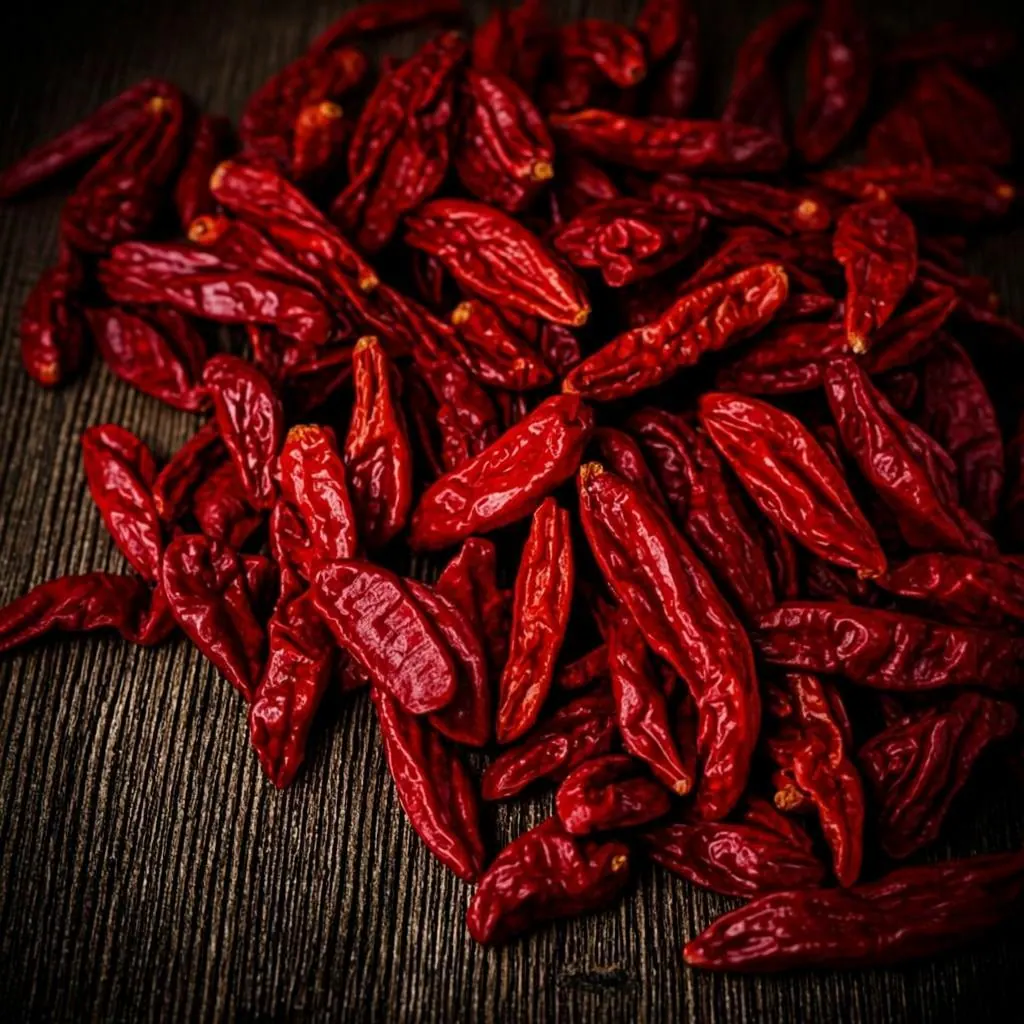
An enquiry for "Indian red chilli, 20 tonnes" is not a specification. India grows chillies that differ by a factor of fifty in extractable colour and by a factor of three in capsaicin content, and the varieties are not interchangeable in any product where either attribute is visible. Choosing the right variety saves more money than any amount of price negotiation on the wrong one.
The figures below come from the Spices Board of India's own chilli catalogue, which is the most useful public reference for orientation because it is the regulator's publication rather than a seller's. Treat them as varietal character, not as lot specifications, and test the lot you are actually buying.
The varieties that matter for export
| Variety | Region | ASTA colour | Capsaicin | Character | Bought for |
|---|---|---|---|---|---|
| Byadgi, Kaddi | Dharwar, Karnataka | 159.9 | Negligible | Wrinkled, deep red, thin skinned | Colour extraction, oleoresin, mild deep-red products |
| Ellachipur Sannam S4 | Amaravathi, Maharashtra | 70.40 | 0.2% | Reddish, hot | Blending, seasoning where both colour and heat are wanted |
| Kashmir chilli | Himachal Pradesh, Jammu and Kashmir | 54.10 | 0.325% | Long, fleshy, deep red | Premium appearance products, tandoori and marinade bases |
| Birds eye, Dhani | Mizoram, Manipur | 41.7 | 0.589% | Very small, blood red, very pungent | Hot sauces, extract heat, speciality retail |
| Hindpur S7 | Hindpur, Andhra Pradesh | 33.00 | 0.24% | Red, highly pungent | Powder and paste where heat leads |
| Guntur Sannam S4 | Guntur, Warangal, Khammam | 32.11 | 0.226% | Thick skinned, hot, red | The volume workhorse. Powder, curry bases, general trade |
| Kanthari, white | Kerala, Tamil Nadu | 2.96 | 0.504% | Short, ivory white, very hot | Speciality and regional products only |
| Jwala | Kheda, Mehsana, south Gujarat | Not published | 0.4% | Short, light red, compact seed | Pungent powder, regional Indian trade |
Two rows in that table do most of the work in the real market. Guntur Sannam S4 is the volume, at 32.11 ASTA and 0.226 percent capsaicin, and it is the reference point most Indian chilli pricing is quoted against. Byadgi is the colour, at 159.9 ASTA with negligible heat, and it is what a colour extraction plant actually wants. Once you know which of those two poles your product sits nearer, most of the varietal decision is made.
Teja, and the honest position on it
Teja is one of the most heavily traded Indian chilli export names, particularly out of Andhra Pradesh and Telangana, and it is usually offered as a high-pungency type at a heat level above Guntur Sannam. It does not appear in the Spices Board's published varietal catalogue.
That is worth stating plainly rather than glossing over, because it has a practical consequence. When a supplier quotes a Teja figure, they are quoting a trade convention, not a value drawn from a published varietal standard. Two suppliers can both honestly describe a lot as Teja and deliver different colour and different heat. The situation is closely analogous to makhana, where the suta size system is widely used and not backed by any published standard, and the response is the same: get the numbers on the certificate of analysis and stop relying on the name. The makhana grading article works through how to pin down a grade that has no standard behind it.
The same caution applies to other names you will meet in offers, including Wonder Hot, Sannam 334, Byadgi Dabbi and various local selections. They are real and they describe real material. They are not published specifications.
Geographical indications, and what they do and do not guarantee
Byadagi chilli and Guntur Sannam chilli both hold Geographical Indication registrations in India. A GI is a protection of origin and reputation. It tells you the material comes from the defined area and follows the defined practice for that GI.
What a GI does not do is fix your lot's colour value, pungency, moisture or cleanliness. Those still have to be contracted and tested. A GI is a useful authenticity signal, particularly where a premium is being paid for a named origin, and it is worth asking for the documentation supporting a GI claim if you are paying for one. It is not a substitute for a specification, and treating it as one is the same error as treating HPS or Teja as a specification.
The attributes no number captures
ASTA colour value and capsaicinoid content are the two figures everyone quotes. Three attributes that materially affect your product do not appear in either.
Skin thickness. Guntur Sannam is described in the Board's own catalogue as thick skinned, Byadgi as thin and wrinkled. Thick skin means more flesh relative to seed, which usually means better colour and body in a paste and a coarser grind behaviour. Thin, wrinkled types grind finer and extract faster. If you are making a paste or a sauce, skin thickness affects yield and texture more than a few ASTA units will.
Seed proportion. Seeds carry little colour and little capsaicin relative to the placental tissue, and they add a gritty texture and a different fat profile to a powder. Deseeded or low-seed grades cost more per kilogram and can be cheaper per unit of usable product. Ask for the seed percentage if you grind.
Pod length and uniformity. Irrelevant for extraction, decisive for whole-pod retail and for any product where the chilli is visible. Kashmir chilli commands its premium substantially on appearance, being long, fleshy and deep red, rather than on its 54.10 ASTA figure alone.
Harvest windows, and when fresh crop is actually available
| Variety | Harvest window |
|---|---|
| Ellachipur Sannam S4 | September to December |
| Birds eye, Dhani | October to December |
| Jwala | September to December |
| Kashmir chilli | November to February |
| Hindpur S7 | December to March |
| Guntur Sannam S4 | December to May |
| Byadgi, Kaddi | January to May |
| Kanthari, white | Available year round |
The practical use of this table is in reading offers. A Byadgi lot offered in November is carrying six months of storage, and since colour value decays with time, heat, light and oxygen, that storage has cost the lot something measurable. The ASTA colour value article explains the decay mechanism and how to contract around it. So ask for the crop year and the harvest window on the certificate of analysis, and treat their absence as a question.
The corollary is that a buyer with a colour-critical product should plan purchasing around the harvest calendar rather than around their own financial year. Buying Byadgi in February and Guntur in January is materially different from buying both in September, and the difference does not show up in the price list.
Whole, stemless, crushed, flakes or powder
The processing form is a separate decision from the variety, and it has its own consequences.
- Whole with stem. Cheapest per kilogram and heaviest per unit of usable material, because stems are weight and volume with no colour or heat. Fine if you have a destemming step.
- Stemless. The common export form. Better colour and pungency per kilogram, better container economics, and the stem allowance becomes the line to contract.
- Crushed and flakes. Intermediate surface area, so intermediate colour decay. Specify the particle size range and the seed content, because flakes are where seed proportion becomes visible to a consumer.
- Powder. Convenient and the fastest to lose colour, because grinding multiplies exposed surface area. Specify mesh size, and specify an opaque or foil-laminated pack: a transparent pack in a lit warehouse will lose colour value that no dispatch certificate can protect.
Buyers who can grind should consider importing whole or stemless and grinding close to use. It preserves colour, and it removes the easiest surface for adulteration, since powder can be diluted or dyed in ways a whole pod cannot.
Compliance is where chilli containers actually get stopped
Variety selection is a commercial decision. These are the ones that decide whether the container clears at all, and chilli attracts more attention than most Indian food commodities.
- Pesticide residues. Chilli is among the most frequently flagged Indian commodities at EU border control posts. The critical structural point is that where no specific maximum residue level is set for a substance and crop, a default applies rather than nothing, which is covered in the EU pesticide MRL article.
- Aflatoxin and ochratoxin A. Both apply to chilli and both are sampling-sensitive. See the aflatoxin article for why the sampling plan matters more than the laboratory.
- Unauthorised colourants. Sudan dyes and similar have a long rejection history in chilli products specifically because they imitate the attribute being sold. Any lot bought on colour should be screened.
- Sterilisation method. Ethylene oxide is a route to rejection for European destinations, and steam is the alternative. The reasoning, including why the residue definition includes a breakdown product that persists, is in the ethylene oxide article.
- Border control listing. Indian chilli products have been subject to intensified official controls, which means a defined sampling percentage and consignments held pending results. How that mechanism works in practice is in the EU border controls article.
How we supply it
We ship whole dry red chillies, stemless red chillies, crushed red chillies, red chilli flakes and red chilli powder against a named variety with tested colour and capsaicinoid figures, the crop year recorded, and the sterilisation method stated on the documents rather than implied.
Where a buyer names a trade grade we cannot tie to a published figure, we quote the tested numbers alongside it, because a name that two suppliers can use honestly for different material is not something either of us should be contracting on.