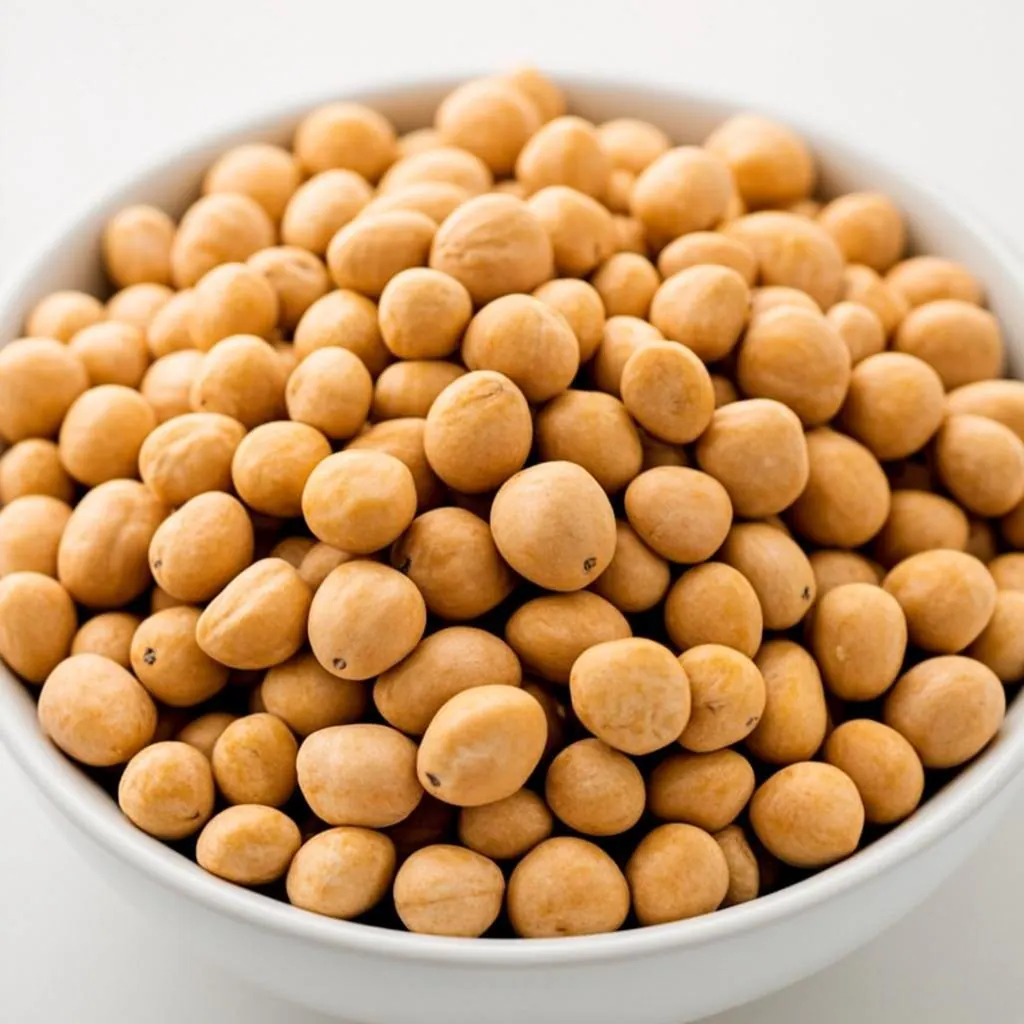
The chickpea trade quotes size as a count, and the count runs backwards from what most people expect. A 42/44 count chickpea is large. A 60/62 is small. Buyers new to the commodity regularly assume the opposite, order the wrong grade, and then discover that the price they thought was a bargain was a bargain for a reason.
This guide explains where the count number comes from, how to convert it into something you can weigh, which size each end market actually buys, and the parameters beyond size that determine whether a container of chickpeas performs in your process.
What count means, and how to check it yourself
Count is the number of seeds in one ounce, which is 28.35 grams. When a supplier offers 42/44 count, they are saying that a representative ounce of that lot contains between 42 and 44 chickpeas. Fewer seeds per ounce means each seed is heavier, so a lower count number is a larger chickpea.
That gives you a check you can run on your own bench with a scale and no special equipment. Divide 28.35 by the count and you have the average seed weight in grams. Or, more practically, count out 100 seeds, weigh them, and compare.
| Count | Average seed weight | Weight of 100 seeds | Indicative screen size |
|---|---|---|---|
| 40/42 | 0.68 to 0.71 g | About 68 to 71 g | 12 mm and above |
| 42/44 | 0.64 to 0.68 g | About 64 to 68 g | About 12 mm |
| 44/46 | 0.62 to 0.64 g | About 62 to 64 g | About 11 mm |
| 46/48 | 0.59 to 0.62 g | About 59 to 62 g | About 11 mm |
| 50/52 | 0.55 to 0.57 g | About 55 to 57 g | About 10 mm |
| 58/60 | 0.47 to 0.49 g | About 47 to 49 g | About 9 mm |
| 60/62 | 0.46 to 0.47 g | About 46 to 47 g | About 8 to 9 mm |
The screen sizes in the last column are indicative. Screens sort on diameter and counts sort on weight, and the two only correlate loosely, because a chickpea that is wide but flat weighs less than a round one of the same diameter. Some suppliers quote in millimetres, some in count, and a few quote both. If you are comparing offers from two origins, convert everything to count and average seed weight before you compare price.
One more thing about how counts are written. A single number like "44 count" usually means "44 count and better", which is not the same as 42/44. Ranges are honest. Single numbers with no range are worth a clarifying email.
Sizing tolerance: what percentage of the lot is allowed to be off-size
No lot is perfectly uniform. Chickpeas are graded over screens, and screens are not perfect either. A normal specification allows some percentage of the lot to fall outside the stated count band, typically 5% and sometimes up to 10%.
This is the clause where money quietly changes hands, so name it. A 42/44 count with a 10% undersize tolerance is a materially cheaper product than the same count with a 3% tolerance, and if your buyer is a canner who visually inspects, the difference is visible in the can. Write the tolerance into the purchase order and state whether it is measured by weight or by count. By weight is the norm and is easier to verify.
Which size does your market actually buy
Paying for the biggest chickpea available is a common and expensive mistake. Size premium in kabuli chickpeas is steep at the top end, because large seed is a smaller share of any crop and cannot be manufactured. Whether that premium is worth anything depends entirely on what happens to the chickpea next.
| End use | Usual count range | Why |
|---|---|---|
| Canning and jarred whole chickpeas | 42/44 to 46/48 | The consumer sees every individual seed. Uniformity and size are the product. Skins must stay intact through retorting. |
| Retail dry packs, premium | 42/44 to 50/52 | Size sells through a transparent pack. Uniformity matters more than absolute size. |
| Hummus and chickpea paste | 50/52 to 60/62 | Everything gets blended. Size is irrelevant to the finished product, so paying for it is pure cost. Consistent hydration matters instead. |
| Roasted and coated snacks | 44/46 to 50/52 | Needs even size for even frying or roasting, but not maximum size. Skin adhesion and low breakage matter. |
| Besan, flour and milling | Smaller counts and off-grades | Milled to powder. Buy on price, moisture and cleanliness. |
| Food service and catering | 46/48 to 58/60 | Cost driven, cooked in bulk. Cooking uniformity beats appearance. |
If you are a hummus manufacturer being offered 42/44 count, the correct response is to ask for a price on 58/60. The finished product will be identical and your ingredient cost will not be.
Kabuli and desi are different crops, not different grades
This gets muddled in enquiries often enough to be worth stating. Kabuli and desi are two distinct types of chickpea, not two quality levels of the same thing.
- Kabuli is the large, round, cream to beige chickpea with a thin seed coat. It is what most of the world means by "chickpea" or "garbanzo". Thin skin, high water absorption, mild flavour, and it is what canners and hummus makers buy.
- Desi is smaller, angular, darker brown, with a thick seed coat and a higher fibre content. It is the dominant type grown and eaten in India. Split and dehulled it becomes chana dal, and milled it becomes besan.
They are not interchangeable in a recipe or in a process. Desi cooks differently, absorbs water differently and tastes stronger. If you have been quoted a surprisingly low price for "chickpeas", check which type you were quoted. We list both, along with black chickpeas and green chickpeas, under whole pulses and legumes.
Crop year and the hard-to-cook problem
If there is one parameter that buyers underweight, it is age. Chickpeas develop what food scientists call the hard-to-cook defect during storage, and it accelerates in warm, humid conditions. The seed coat and the cell walls change, the seed absorbs water more slowly, and cooking time goes up. Soaking helps but does not undo it.
For a canner this is a serious operational issue, because cooking time is fixed by the retort schedule. Old crop chickpeas run through a schedule tuned for new crop come out firm in the centre, and you find out at the end of the line. For a home consumer buying a retail pack, it means the cooking instructions on your own packaging stop being true.
India harvests kabuli chickpeas as a rabi crop, sown around October and November and harvested from February into April, with Madhya Pradesh, Maharashtra, Karnataka, Gujarat and Rajasthan as the main growing states. New crop material is available from March. Write the crop year on the purchase order. If you are buying in December for a January shipment, ask specifically whether it is that year's crop or the previous one, and adjust either your price or your cooking schedule accordingly.
A related point on cooking quality. If it matters to your process, put a hydration ratio on the specification: soak a weighed sample for a defined time at a defined temperature and record the weight gain. Sound kabuli chickpeas roughly double in weight. A lot that reaches only 1.8 times is telling you something about age or storage that the visual inspection will not.
Defects and cleaning grades
"HPS" appears on almost every kabuli chickpea offer. It stands for hand picked selected, and it describes a process, not a guaranteed outcome. In practice it means the lot was machine cleaned, graded, usually colour sorted, and then passed over a manual picking belt. How many people stood at that belt and how fast it ran are what determine the result. So specify the defects, not the acronym.
| Parameter | Typical specification | Why it matters |
|---|---|---|
| Moisture | 12% maximum, 10 to 11% preferred | Above 12% you take on mould risk in transit and you are paying for water. |
| Foreign matter | 0.1% maximum, stones nil | Stones damage mills and are a consumer safety issue. |
| Other pulses admixture | 0.5% maximum | A desi chickpea in a kabuli pack is instantly visible. |
| Splits and broken | 1.0% maximum | Splits fall apart in canning and look like damage in a retail pack. |
| Shrivelled and wrinkled | 1.0 to 2.0% maximum | Hydrate unevenly and look poor. Usually a growing season stress signal. |
| Insect damaged | 0.5% maximum, live infestation nil | A live weevil at the destination port can cost you the container. |
| Discoloured and off-colour | 1.0 to 2.0% maximum | Mostly cosmetic, but retail buyers reject on it. |
| Total defects | 2.0 to 3.0% maximum | Sum clause, so that individual tolerances cannot stack. |
Insect infestation deserves its own line. Chickpeas are attractive to bruchid beetles, the damage develops in storage rather than in the field, and eggs laid before shipment can hatch during a warm voyage. A container that was clean at the load port can arrive with live insects. This is why fumigation is standard on pulse shipments and why the fumigation certificate matters. We cover which certificate does what in documents required to export food products from India.
Packing and container loading
Chickpeas are a dense cargo at roughly 800 to 850 kg per cubic metre. A 20ft container reaches its weight limit long before it runs out of space, which makes the loading arithmetic simple: you load to the payload and you stop.
- 50 kg PP woven bags, around 520 to 540 bags in a 20ft container, giving about 26 to 27 MT.
- 25 kg bags for retail-bound and food service material, roughly the same total weight in twice the bag count.
- 1 MT jumbo bags where the destination has the handling equipment, faster to load and discharge.
- Bulk in a lined container for crushers and large processors, which saves bag cost but needs the right discharge facility at your end.
Watch the road weight limit at your destination, which is often lower than the container rating and is the real constraint. A 20ft rated to carry 28 MT is no use if your local regulations cap the axle load at 24 MT. The details, including how to think about volume versus payload for every commodity, are in how many tonnes fit in a 20ft container.
How we quote it
We quote kabuli chickpeas by count with the tolerance stated, and we will tell you the crop year without being asked. If you tell us the end use, we will tell you which count actually fits it, including when that means selling you a cheaper grade than the one you asked for. Every shipment carries a lot-specific certificate of analysis and a sealed retained sample.
Our kabuli chickpea page lists the counts we hold, and you can send us a specification to price.