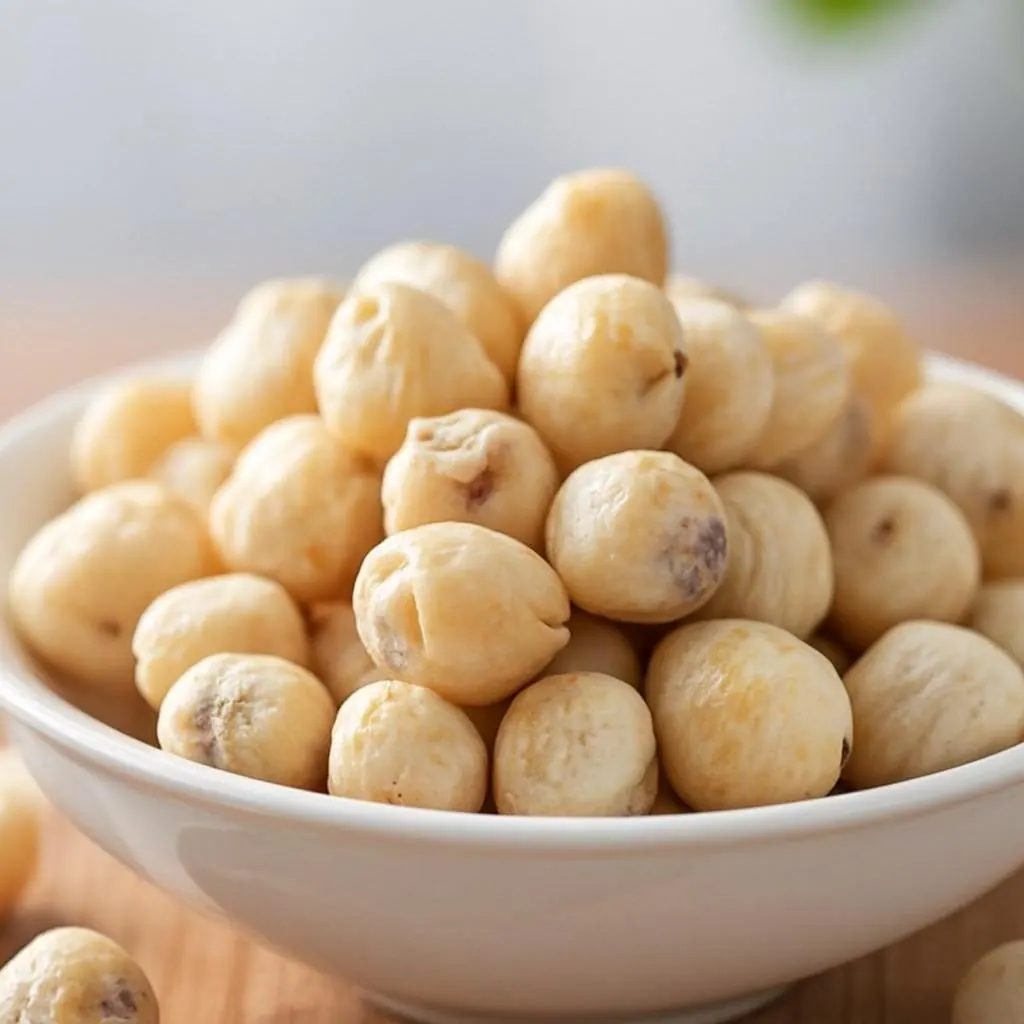
Makhana has gone from a regional Indian ingredient to a global snack input in about a decade, and the buying side has not caught up. Most enquiries we receive ask for "premium makhana" or "big size makhana", which is a bit like ordering "large coffee" with no cup size in mind. Meanwhile the sellers quote grades in a traditional unit that has never been standardised, so two suppliers can both honestly offer you "5 suta" and send you visibly different products.
This is a guide to what the grades mean, what else you should be specifying alongside size, and why makhana behaves so differently from every other commodity in a container. If you are sourcing fox nuts for a snack line, a retail pack or an ingredient blend, this is the vocabulary you need.
What makhana actually is, and why grading exists at all
Makhana is the popped kernel of Euryale ferox, an aquatic plant grown in shallow ponds. In English it goes by fox nut and gorgon nut, and it is not related to the lotus despite the "lotus seed" label you sometimes see on retail packs. The overwhelming majority of world production comes from Bihar, concentrated in the Mithila region across districts including Darbhanga, Madhubani, Purnia and Katihar. Mithila Makhana carries a Geographical Indication registration.
The processing is what creates the grades. Divers collect seed from the pond bed, it is washed, sun dried, and then sorted by size before popping. That pre-popping size sort is the origin of the grading system, because size going in determines size coming out. The graded seed is tempered, roasted in a cast iron pan at high heat, and struck with a wooden mallet so the white kernel bursts out of its hard black shell. Then it is polished and graded again.
Two consequences follow from that process, and both affect your purchase. First, recovery is low. Roughly a third of the raw seed weight comes out as saleable popped makhana, which is why makhana costs what it costs. Second, popping is done in small batches by skilled hands, so consistency is a function of the operation you are buying from rather than of the crop. This is a product where the processor matters more than the origin.
The suta grading system
Suta is a traditional sizing unit used through the Bihar trade. In practice it functions as a sieve size: seed is passed over graded screens, and the grade name refers to the screen it was retained on. A higher suta number means a larger kernel and a larger pop.
Here is the part every buyer needs to hear clearly. The suta numbers are not backed by a published standard. There is no gazette notification, no ISO number and no industry body that fixes the millimetre band for "5 suta". Different processors calibrate their screens slightly differently, and some quote in suta while others quote in their own house grades like Lava, Superior, Special or HMT. The numbers below are indicative of common trade practice, and you should treat them as a starting point for a conversation, not as a specification.
| Trade grade | Indicative kernel diameter | Character | Typical use |
|---|---|---|---|
| 6 suta and above (often "Lava" or "Special") | About 21 mm and up | Largest, whitest, most uniform, highest price | Premium retail packs, gifting, photography-led branding |
| 5 suta (often "Superior") | About 18 to 21 mm | Large and uniform with few defects | Retail snack packs, flavoured and roasted lines |
| 4 suta | About 15 to 18 mm | Good size, slightly more variation | Mainstream retail, food service, roasted snacks |
| 3 suta | About 12 to 15 mm | Smaller, more variation, better value | Ingredient use, trail mixes, bulk food service |
| Mixed or "khichdi" | Ungraded blend | Whatever the line produced | Powder and flour, industrial ingredient use |
| Thurri | Broken pieces and fragments | By-product of grading and handling | Milling into makhana powder, animal feed |
The practical way to buy is this. Ask for the grade name your supplier uses, ask for the screen size in millimetres behind it, and then ask for a sealed 500 g sample from a real production lot. Approve the sample, keep half of it, and write the sample reference number into the purchase order. When a shipment arrives you are then comparing physical objects rather than adjectives. This single step removes most makhana disputes.
Pop percentage, and why it matters more than buyers expect
Not every seed pops. In any lot you will find kernels that only partially burst and hard unpopped seeds that never opened. The trade calls the good fraction pop percentage or bursting percentage. Well run lines deliver 95% and above. Lots at 90% are common. Below that you are buying a problem.
Here is why it matters out of proportion to the number. An unpopped kernel is a small, extremely hard object with a shell on it. In a retail snack pack it is a dental complaint. In a food service setting it is a customer complaint. And unpopped kernels are heavier than popped ones, so a 5% unpopped fraction is a larger share of your weight than of your count. You are paying premium makhana prices for stones.
Specify a minimum pop percentage, specify a maximum for unpopped and partially popped kernels separately, and ask how they are removed. Good processors run a gravity separator or an air classifier after popping precisely because unpopped kernels are denser. If the answer is "hand picking", ask how many people and how many kilos per hour.
Moisture and texture: the parameter that decides whether it is still crisp
Popped makhana is a low density, highly porous starch structure. That makes it wonderfully crisp and also extremely hygroscopic. It pulls water out of the air quickly, and once it has, the crispness is gone. Rehydrated makhana goes leathery and slightly chewy, and no amount of re-drying restores the original texture properly.
Ship at 6% moisture or below and specify 7% as an absolute maximum. If your own process involves roasting or flavouring, you can be a little more relaxed, because you will be driving moisture off anyway. If you are packing it as is for retail, be strict.
Packaging carries as much of the burden as the moisture figure. Makhana needs a genuine moisture barrier, which means a sealed multi-layer liner inside the carton at minimum. Nitrogen flushing on retail units extends shelf life and protects texture, and is worth its cost for anything premium. A plain woven bag will deliver you soft makhana, no matter what the certificate of analysis said at the load port.
The other quality parameters worth naming
- Whiteness and colour uniformity. Makhana ranges from bright white to cream to slightly grey. Colour comes from the pond, the drying and the roast. Grey or spotted kernels are usually a drying problem. Specify by sample rather than by adjective.
- Black spots and shell fragments. Bits of the black seed coat that survived popping and polishing. Highly visible against a white kernel, so retail buyers should specify a low tolerance, often 1% or less by count.
- Broken percentage. Handling breaks makhana. A maximum of 2% to 3% broken is reasonable for graded material. Long transport and rough handling push it up, which is another argument for cartons over bags.
- Foreign matter. Should be zero for anything retail bound. Ask whether the line runs a metal detector, and at what sensitivity, if you are packing for retail.
- Microbiology. Makhana is roasted, which helps, but it is then handled, polished and packed. If you need Salmonella absent in 25 g and a total plate count limit, say so, because it changes how the line has to be run.
- Pesticide residues and heavy metals. Makhana grows in ponds, and pond water quality varies. If you are shipping to the EU or Japan, put a heavy metals panel and a multi-residue pesticide panel on the specification and ask for lot-specific results from an ISO/IEC 17025 accredited laboratory.
Why makhana breaks your usual freight arithmetic
This is the part that surprises first-time buyers, sometimes expensively. Makhana has a bulk density in the region of 90 to 110 kg per cubic metre once packed. Pulses run around 800 to 850. Makhana is, for shipping purposes, about eight times lighter than the commodity your logistics team is used to.
Work it through. A 40ft high cube container gives you roughly 76 cubic metres of internal volume, of which you will realistically use around 85% once you account for stacking patterns, dunnage and the gap at the door. Call it 65 usable cubic metres. At 100 kg per cubic metre that is about 6.5 MT. Real shipments land somewhere between 5 and 7 MT depending on carton size and how tightly the line packs.
| Container | Usable volume | Makhana at about 100 kg/cbm | Pulses at about 820 kg/cbm |
|---|---|---|---|
| 20ft general purpose | About 28 cbm | About 2.5 to 3 MT | Payload limited at about 26 to 27 MT |
| 40ft general purpose | About 58 cbm | About 5 to 6 MT | Payload limited at about 27 to 28 MT |
| 40ft high cube | About 65 cbm | About 5 to 7 MT | Payload limited at about 27 to 28 MT |
The commercial consequence is that ocean freight per kilogram of makhana is roughly four to five times what it is per kilogram of chickpeas on the same route. If you are building a landed cost model, do not reuse the freight assumption from your pulses programme. And when you are comparing two quotes, check whether both are quoting the same container type, because a supplier quoting a 40ft high cube against another quoting a 40ft standard is quoting about 15% more cargo.
It also means consolidation is often the right answer for a first order. A 2 MT trial in a shared container beats waiting until you can justify a full 40ft. The full loading arithmetic across our range is in how many tonnes fit in a 20ft container.
Customs classification: get this confirmed, do not guess
Makhana classification depends on what has been done to it. Raw dried seed, plain popped kernels, roasted kernels and flavoured or seasoned kernels can fall under different headings, and duty and any preferential treatment follow the heading. Different destinations have taken different views on the same physical product.
We are not going to publish a single HS code here, because the honest answer is that you should confirm it with your customs broker for your destination and your exact product form before you contract. Ask your supplier what code has been used on previous shipments to your country and whether any of them were challenged. That question is worth more than any code we could print.
Supply concentration is a real risk, and you should plan for it
A handful of Bihar districts supply the world. Production depends on ponds, monsoon behaviour and a skilled manual popping workforce. Capacity does not expand quickly. When global demand jumps, as it has repeatedly over the last few years, the price moves fast and the larger grades tighten first, because a bigger pop requires a bigger seed and the size distribution of the crop is what it is.
Three things follow if makhana is important to your business:
- Contract your larger grades earlier than feels necessary. The 6 suta and 5 suta material runs short before anything else does.
- Design your product so it can tolerate a grade shift. If your pack works at both 5 suta and 4 suta, you have a buffer that your competitor who specified only 6 suta does not.
- Build the relationship before you need it. In a tight market, allocation goes to buyers with a history, and this is a trade that still runs substantially on relationships.
How we handle it
We grade to screen size and tell you the millimetres, not just the suta number. Every quotation goes out with a sealed sample from a real lot, and we retain the counter-sample against your purchase order number. We will also tell you honestly when a smaller grade will do the same job for your pack, because a customer who overpaid for size they did not need does not come back.
You can see the forms we ship on our makhana product pages, covering natural, roasted, flavoured and powder, and you can send us your specification to price against.