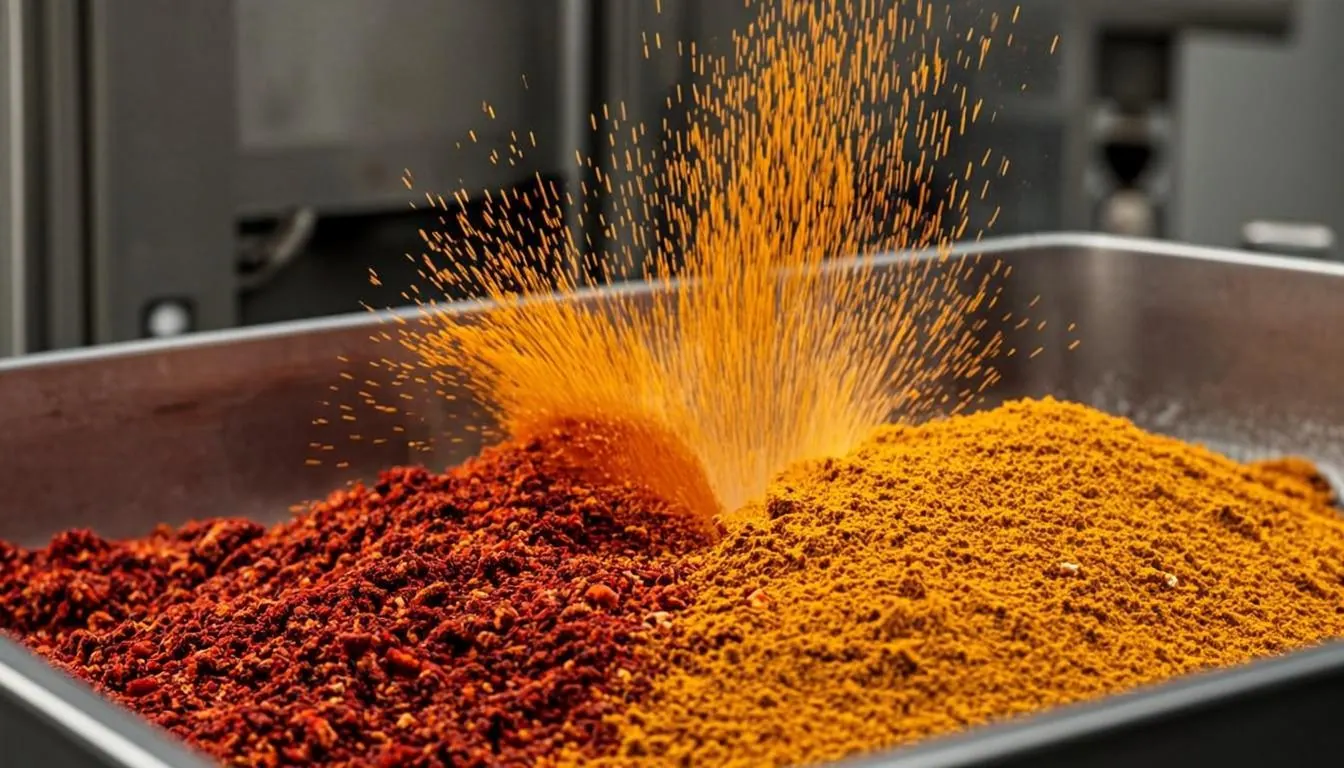
Ethylene oxide is a gas used in several countries to reduce microbial load in dry commodities, particularly spices and seeds, where the product cannot be heat treated without damaging it and where Salmonella is a real concern. It works. It is also not authorised as a plant protection product in the European Union, and the consequence of that non-authorisation is stricter than most exporters expect: with no specific maximum residue level set for most crops, the default of 0.01 mg/kg under Article 18 of Regulation (EC) No 396/2005 applies. That is at the analytical limit, so in practical terms the residue must not be detectable.
The part that surprises people is what gets detected. Ethylene oxide is reactive and short-lived in a food matrix. It reacts with chloride to form 2-chloroethanol, which is stable and stays put. The EU residue definition covers the sum of ethylene oxide and 2-chloroethanol, expressed as ethylene oxide. So the compound found in a laboratory report months or years after treatment is usually the breakdown product, and the result calculated from it is expressed as though it were the gas.
Why this makes treatment history, not recent treatment, the risk
If the analyte were the gas alone, time would solve the problem. It is not, so time does not. A lot treated at origin and shipped, stored, blended and repacked can still carry a detectable 2-chloroethanol level at the far end of that chain, and it will be reported as an ethylene oxide result.
Three consequences follow that are worth planning around.
Blending propagates it. A single treated component blended into a formulation carries its residue into everything the formulation touches. This is how one lot becomes a recall covering dozens of finished products.
The chain does not forget. Because the marker is persistent, a residue can surface at any point downstream, including in a product where the original supplier is no longer identifiable without a traceability exercise.
Segregation has to be physical. A supplier who treats for one market and not another needs separated silos, separated conveying, separated packing and a validated cleaning regime between them. A written assurance without that physical separation is not worth much, because the transfer mechanism is dust and residue on shared contact surfaces.
The sesame case, and what it demonstrated
In 2020 elevated ethylene oxide was found in sesame seeds of Indian origin arriving in the European Union. The commercial shape of what followed is the instructive part.
The affected material was not sitting at a border waiting to be inspected. It was already inside European supply chains, in bakery products, in seasonings, in tahini, in seeded breads and in multi-ingredient formulations. The response therefore was not a series of border rejections but a large, extended recall exercise running downstream through many manufacturers, with the persistent marker making it possible to trace and impossible to ignore.
Two lessons for a buyer. First, the residue question is not only a border question, it is a product liability and recall exposure question, which changes how much verification is worth paying for. Second, sesame specifically remains a commodity where a buyer should require an ethylene oxide result on the lot rather than a general assurance about site practice. The other sesame compliance issues, including Salmonella and the difference hulling makes, are covered in the sesame quality article.
Testing for it properly
Ethylene oxide and 2-chloroethanol do not appear on a standard multi-residue screen. They are volatile, and the determination is a dedicated headspace method with gas chromatography and mass spectrometry. It has to be ordered by name.
| Requirement | What to ask for |
|---|---|
| Analytes | Both ethylene oxide and 2-chloroethanol, reported separately and as the sum expressed as ethylene oxide |
| Method | Dedicated headspace GC-MS, not the multi-residue screen |
| Limit of quantification | At or below 0.01 mg/kg for each analyte, stated on the report |
| Accreditation | ISO/IEC 17025 covering this specific method |
| Sampling | To a defined plan by a named surveyor, on the lot being shipped |
| Matrix | Tested on the product as it will be presented, not on an untreated reference |
A report that says "no pesticide residues detected" from a multi-residue screen tells you nothing about ethylene oxide. This is the same trap described in the EU pesticide MRL article, where a set of commercially important substances sit outside standard screens and have to be requested individually.
Saturated steam, the alternative that actually works
Steam sterilisation, sometimes described as steam pasteurisation, passes saturated steam through the product under controlled temperature, pressure and time, then dries and cools it. It achieves meaningful microbial reduction, it leaves no residue to declare, and it is accepted in every major market.
It is not free. Steam costs you some of the volatile fraction, and in a spice the volatile fraction is the flavour.
| Commodity | What steam costs you | How to manage it |
|---|---|---|
| Cumin | Volatile oil, which is the parameter flavour actually tracks | Contract volatile oil after treatment, and buy a higher starting figure |
| Chilli | Some extractable colour, and some aroma | Contract ASTA value tested after treatment, dated |
| Coriander and similar seeds | Volatile oil and some aroma top notes | Same as cumin. Specify post-treatment figures |
| Sesame | Minimal flavour cost, some effect on skin appearance in natural seed | Watch free fatty acid, since heat plus moisture accelerates hydrolysis |
| Pulses | Little flavour cost, but cooking behaviour can shift | Test a cook trial before committing a large volume |
The contractual instruction that follows is simple and often missed: specify the parameter after treatment, not before. A cumin lot quoted at a volatile oil figure measured before steam and delivered after steam has lost some of what you paid for, and neither party has lied. Ask for both numbers, treat the loss as a known cost, and adjust the purchase specification upward to land where you need. The volatile oil discussion in the cumin grades article covers why that parameter matters more than the purity headline.
Two other practical points about steam. The process reintroduces moisture, so the drying and cooling steps afterwards are where a badly run line does its damage, and a lot leaving a steam plant at elevated moisture is a mould problem waiting for a sea voyage. And validation matters: ask for the log reduction the plant validates against, for which organism, and how often the validation is repeated.
Irradiation, and the narrow gate it goes through
Irradiation is effective and it is lawful in the European Union only within a tightly limited scope. Directive 1999/2/EC sets the framework and Directive 1999/3/EC establishes the Community list, which contains a single category: dried aromatic herbs, spices and vegetable seasonings. Treated food must be labelled as having been irradiated, and treatment must take place in an approved facility.
Read carefully, that means three things for an Indian exporter. Irradiation is available for spices, subject to the labelling requirement. It is not available at EU level for pulses, oilseeds or nuts, so it is no answer at all for sesame, groundnut or chickpea. And the mandatory label is a commercial decision as much as a regulatory one, because some buyers and some retail channels will not take irradiated product regardless of its legality.
Member states may permit additional categories nationally within the framework, which is a genuine complication if you ship into several EU markets. Confirm the position for the specific destination rather than assuming the Community list is the whole picture.
Comparing the routes
| Route | Microbial efficacy | Residue to declare | EU acceptance | Cost to specification |
|---|---|---|---|---|
| Ethylene oxide | High | Yes, and persistent as 2-chloroethanol | Not authorised as a plant protection product | None, but the lot cannot enter |
| Saturated steam | Good, and validatable | None | Accepted | Volatile oil, some colour, and a drying step to control |
| Irradiation | High | None, but a mandatory label | Only for the authorised category, spices and dried herbs | Little, but the label limits the market |
| Cleaning and sorting alone | Partial | None | Accepted | None, but insufficient where Salmonella is the hazard |
The last row deserves a word, because it is the honest starting point. Good agricultural practice, dry storage, effective cleaning, colour sorting and low water activity reduce microbial load substantially and are the foundation under any of the other three. What they do not do is give you a validated kill step, so for a product with a genuine Salmonella hazard and a customer requiring a validated reduction, cleaning is a prerequisite rather than an answer.
What to require, in writing
How we handle it
We do not use ethylene oxide. Where a microbial reduction step is required we use saturated steam and quote the specification after treatment, so the volatile oil or colour figure on the contract is the figure that arrives rather than the figure the lot had before processing. Ethylene oxide and 2-chloroethanol are tested by dedicated headspace method on lots going to European destinations, with the limit of quantification stated on the report.
The wider residue framework, including why a substance with no listed limit is subject to the strictest limit in the regulation, is set out in the EU pesticide MRL article.