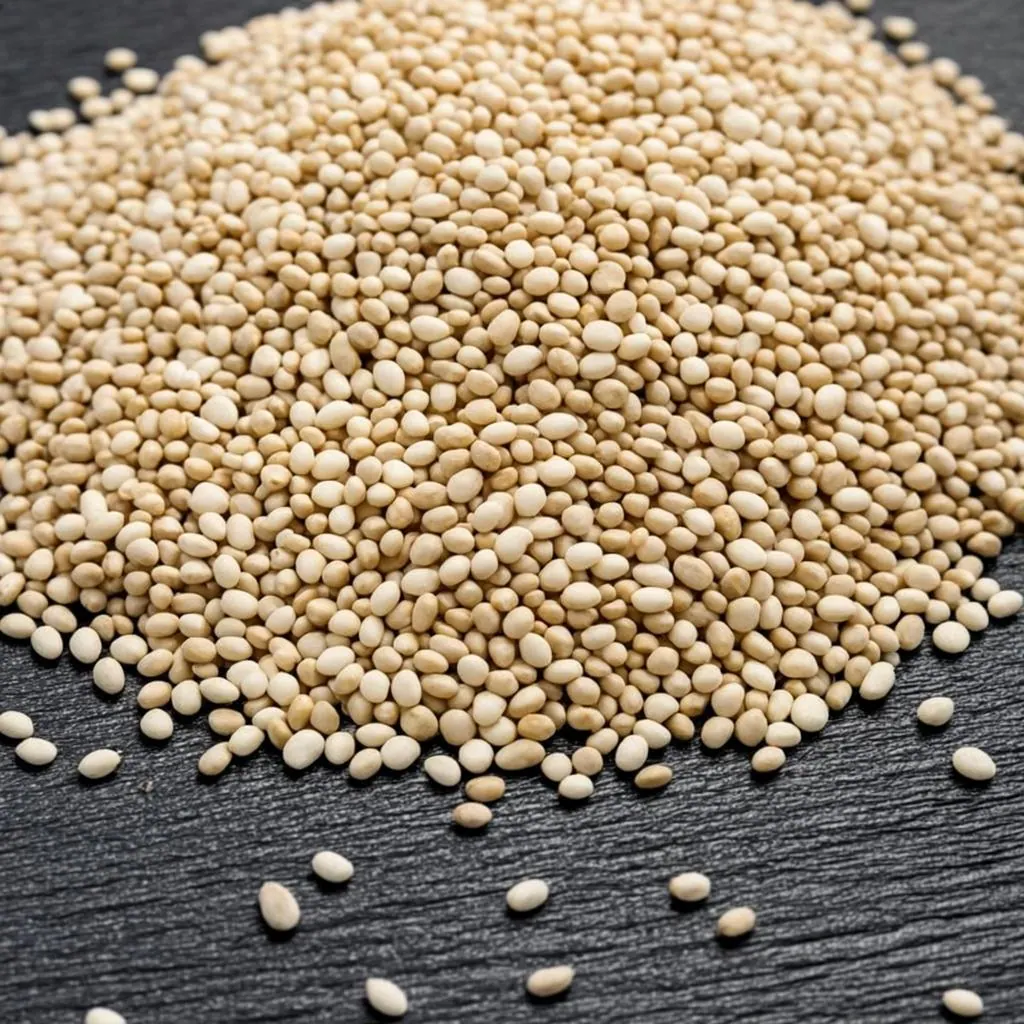
Sesame is one of the oldest cultivated oilseeds and one of the most misordered. A buyer asks for "white sesame seeds" and receives natural whitish seed when they wanted hulled. Another asks for hulled at 99.5% purity to save money, then finds hull fragments visible on top of a bun. A third specifies everything correctly and gets stopped at a European port over a residue nobody mentioned during negotiation.
This guide is the vocabulary and the numbers. What hulled and natural actually mean, what the purity grades are counting, which parameters decide whether the seed performs, and the two compliance issues that cause the most problems for Indian sesame in export markets.
Natural and hulled: two products, not two grades
Natural sesame is the whole seed with its coat intact. Hulled sesame, sometimes called decorticated, has had that coat removed. That single processing step changes almost everything about the product.
| Natural (unhulled) | Hulled (decorticated) | |
|---|---|---|
| Appearance | Off-white, cream, brown or black depending on variety | Uniform bright white, glossy |
| Flavour | Fuller, slightly bitter note from the coat | Milder, cleaner, sweeter on roasting |
| Calcium and fibre | Higher, both sit largely in the coat | Lower, the coat has been removed |
| Oxalate content | Higher, concentrated in the coat | Much lower |
| Shelf life | Longer, the coat protects the oil | Shorter, the oil is exposed |
| Main buyers | Oil crushers, tahini in some markets, bakery toppings where flavour is wanted, Japanese and Korean food use | Bakery toppings, confectionery, halva, tahini, snack coatings, sesame oil for premium use |
| Price | Lower | Higher, because of processing cost and yield loss |
Two frequent mix-ups worth clearing up. First, "white sesame" usually describes a natural whitish variety, not hulled seed, so if you want hulled then write hulled. Second, hulling costs yield. Removing the coat takes roughly 8% to 12% of the weight away, and that loss plus the processing is most of the price gap. Nobody is charging you more for a better crop.
We supply natural sesame seeds, hulled sesame seeds, and the white, brown and black varieties separately, because they are genuinely different orders.
How hulling is done, and why you should ask
There are two broad routes to a hulled seed, and they produce measurably different products. Most suppliers will not volunteer which one they use. Ask.
Wet or water hulling
The seed is soaked in water, sometimes with a mild alkali or salt to loosen the coat, then rubbed to separate the hull, washed, floated to remove the hull fragments, and dried. This is the traditional route and it gives the whitest, cleanest looking seed, which is why premium bakery and confectionery grades usually come from it.
The trade-off is that you have deliberately wetted a food product and now have to dry it back down. If the drying is slow, incomplete or done in the open, you have created ideal conditions for microbial growth on a seed that was previously dry and stable. This is the point in the chain where most sesame contamination originates, and it is why the drying method matters more than the whiteness that gets photographed.
Dry or mechanical hulling
The coat is removed by abrasion in a mechanical huller, with no water introduced. The seed stays dry throughout, so the microbiological risk profile is better. The result is usually slightly less bright and can carry more surface scuffing and a marginally higher broken percentage.
If you are packing sesame for retail, wet hulled with verified drying and a treatment step is likely what you want. If you are using sesame as an ingredient inside something and appearance is secondary, dry hulled is often the smarter buy. Either way, the question to put in writing is: how was it hulled, how was it dried, and what happened after drying.
Purity grades: what 99.5, 99.95 and 99.98 are counting
Hulled sesame is quoted at purity grades, and the number is the percentage of the lot that is sound, clean, hulled seed. The remainder is unhulled seed that escaped the huller, hull fragments, broken and damaged seed, off-colour seed and foreign matter.
| Grade | What the balance contains | Suits |
|---|---|---|
| 99.5% | Up to 0.5% off-spec: some unhulled seed, hull fragments, broken and discoloured seed | Halva, tahini, confectionery fillings, anything ground or blended where the seed is not seen individually |
| 99.95% | Up to 0.05% off-spec, usually after an additional colour sorting pass | Mainstream bakery toppings, snack coatings, food service |
| 99.98% | Up to 0.02% off-spec, after multiple colour sorting passes and often manual picking | Premium bakery, retail packs, Japanese and Korean buyers, anywhere a single dark seed on a white bun is a complaint |
The honest framing on price. Going from 99.5 to 99.98 means more sorting passes, and every pass rejects good seed alongside bad, so the yield falls and the cost per tonne rises. That premium is worth paying when the individual seed is visible in your finished product and worth nothing when it is not. A tahini plant buying 99.98% is grinding money into paste.
One caution: "purity" as a headline number does not tell you the split of what is in the balance. Half a percent of hull fragments is cosmetically different from half a percent of unhulled seed, which is different again from half a percent of stones. Specify a maximum for unhulled seed separately, and specify foreign matter and stones at nil. That way the grade name and the actual defects are both nailed down.
The specification parameters that decide performance
| Parameter | Typical specification | Why it is on the sheet |
|---|---|---|
| Purity | 99.5% to 99.98% for hulled, 99% and above for natural | The headline grade. Specify what the balance may contain. |
| Moisture | Max 5% for hulled, max 6% for natural | Above this you are inviting mould and rancidity in transit and paying for water. |
| Oil content | 48% to 52% | What a crusher is actually buying. Also a variety and growing season indicator. |
| Free fatty acid (as oleic acid) | Max 2.0%, often max 1.5% for premium | Measures hydrolysis of the oil. Rises with wet seed, heat and age. |
| Peroxide value | Max 10 meq O2/kg, lower is better | Measures oxidation. This is the number that tells you how close the seed is to tasting rancid. |
| Foreign matter | Max 0.05% for hulled, max 0.5% for natural, stones nil | Stones damage mills and are a consumer safety issue. |
| Admixture (other seeds) | Max 0.2% to 0.5% | Other oilseeds change oil profile and can carry allergen implications. |
| Broken and damaged seed | Max 1.0% to 2.0% | Broken seed oxidises faster and looks poor as a topping. |
| Unhulled seed in hulled lots | Named separately, tied to the purity grade | The most visible defect in a white product. |
| Insect infestation | Live nil | A live insect at the destination port can cost you the container. |
Why free fatty acid and peroxide value matter more for hulled seed
Sesame is about half oil, and the seed coat is a natural barrier that slows oxygen and moisture reaching that oil. Remove the coat and you have exposed a high-fat food to air. Hulled sesame therefore ages faster than natural, and the ageing shows up first as a rising peroxide value and then as a flavour you cannot sell.
The practical steps: put both numbers on the specification, require them measured on the shipped lot rather than quoted as typical values, and think about the calendar. Hulled sesame that sits in a warehouse in Gujarat through May and June before shipping arrives in a different condition from the same lot shipped in February. Ask for the hulling date, not just the packing date. Those are frequently not the same week.
Salmonella is the risk to plan around
When people think about food safety in agricultural commodities they usually think about aflatoxin. For sesame the bigger and more frequent problem has been Salmonella. Sesame is grown low to the ground, harvested and dried in contact with soil, and in the wet hulling route it is deliberately soaked and then dried again. Any one of those steps can introduce contamination, and unlike a mould toxin, a bacterium can enter the product after the field.
What follows for a buyer:
- Specify Salmonella absent in 25 g, and specify how many sample units are tested. "Absent in 25 g" on a single unit from a 19 MT container is a much weaker statement than the same result across a proper sampling plan.
- Ask what kill step exists. Sesame is often eaten without further cooking, on a bun that is baked before the seed goes on it, or in tahini which is never heated. If there is no kill step in your process, there must be one in the supply chain.
- Steam treatment is the mainstream answer. Saturated steam applied for a controlled time reduces the microbial load without leaving a residue, and it can be validated. Ask for the validation, the log reduction claimed, and how the process is monitored on the day your lot runs.
- Ask about recontamination controls after treatment. A validated steam step followed by handling on the same equipment that moved untreated seed achieves very little. Ask whether treated and untreated material are physically separated.
- Get lot-specific certificates from an accredited laboratory. ISO/IEC 17025 accreditation for the test in question, with the lot number on the report matching the lot number on your packing list.
Ethylene oxide: the compliance issue that stops containers
This deserves its own section because it has caused more disruption to Indian sesame exports than any quality parameter. Ethylene oxide is a gas that has been used in some parts of the world as a microbial treatment for spices and seeds. It works. It is also a genotoxic carcinogen, and the European Union does not permit it as a plant protection product, so the effective residue limit is set at the level of analytical determination. In practice that means a finding at all is a non-compliance.
The part that catches suppliers out is the chemistry. Ethylene oxide reacts with chloride in the product to form 2-chloroethanol, also called ethylene chlorohydrin, and that breakdown product persists long after the gas itself is gone. EU enforcement measures the sum of ethylene oxide and 2-chloroethanol, expressed as ethylene oxide. So a lot treated months earlier, or a lot that only shared a fumigation chamber or a warehouse with treated material, can still test positive. Rinsing, re-drying and airing do not fix it.
Three concrete instructions:
- Write a no ethylene oxide clause into the contract, covering the seed, the packing material and every facility it passed through, not just the final treatment step.
- Require an ethylene oxide and 2-chloroethanol test on the shipped lot, reported as the sum expressed as ethylene oxide, from an accredited laboratory. Do not accept a facility-level declaration in place of a lot result.
- Ask directly whether the processor handles ethylene oxide treated product anywhere on the site for any market. If they do, your exposure is cross-contamination and it does not depend on their intentions.
Sesame seeds from India have appeared in the annexes of the European Union's Regulation (EU) 2019/1793 for ethylene oxide, meaning consignments face intensified checks or a certificate plus sampling requirement at the border. The annex a product sits in and the testing frequency are reviewed roughly every six months, so check the current consolidated text before you contract rather than relying on what was true last season. We explain how those annexes work, and what the certificate and clock mean in practice, in how EU border controls work for Indian food imports.
Origin, crop calendar and classification
India is one of the world's largest producers and exporters of sesame. Growing is spread across Gujarat, Rajasthan, Madhya Pradesh, Uttar Pradesh, West Bengal, Tamil Nadu and Karnataka, and because sesame is grown in more than one season, material is available for much of the year. The main kharif crop is sown with the monsoon and harvested from around September to November, with summer crops in some states adding volume around March to May.
That multi-season availability is a genuine advantage for a buyer, but only if you ask which crop you are being offered. Put the crop and harvest month on the purchase order, the same way you would for a pulse.
On classification, sesamum seeds fall under HS heading 1207.40, whether or not broken. Hulled seed is still classified here, since hulling is not treated as a change that moves the heading. Confirm the national subheading with your broker, because the eight and ten digit splits differ by country and some destinations separate hulled from natural at that level.
Packing, storage and container loading
Sesame has a bulk density around 600 to 650 kg per cubic metre, which is lighter than pulses. A 20ft container of bagged sesame typically carries roughly 18 to 19 MT, so you fill the box on volume at about the same point as you approach a comfortable payload.
- 25 kg or 50 kg PP woven bags for natural seed and for industrial hulled.
- 25 kg multi-layer paper or PP bags with a liner for premium hulled, because the liner is doing real work against moisture pickup.
- Vacuum or nitrogen flushed cartons for high-grade hulled going to Japan, Korea and premium retail, where peroxide value on arrival is part of the specification.
- 1 MT jumbo bags for crushers with the handling equipment.
Line the container with kraft paper and load desiccant. Sesame at 5% moisture in a steel box crossing from the Arabian Sea into a cold European winter will meet the dew point somewhere, and the water that condenses on the ceiling comes down on your top layer. This is not exotic, it happens on ordinary shipments, and it is cheap to prevent. The full arithmetic and the container rain problem are covered in how many tonnes fit in a 20ft container.
How we handle it
We are in Gandhidham in Kutch, in one of India's sesame growing and processing belts and next to Mundra port. We will tell you the hulling method and the hulling date without being asked, we ship against lot-specific certificates of analysis rather than typical values sheets, and we will tell you when a 99.5% grade does the same job as a 99.98% for what you are making.
You can compare the forms we ship across our oilseeds and groundnuts range, or send us your specification and we will price it as written.