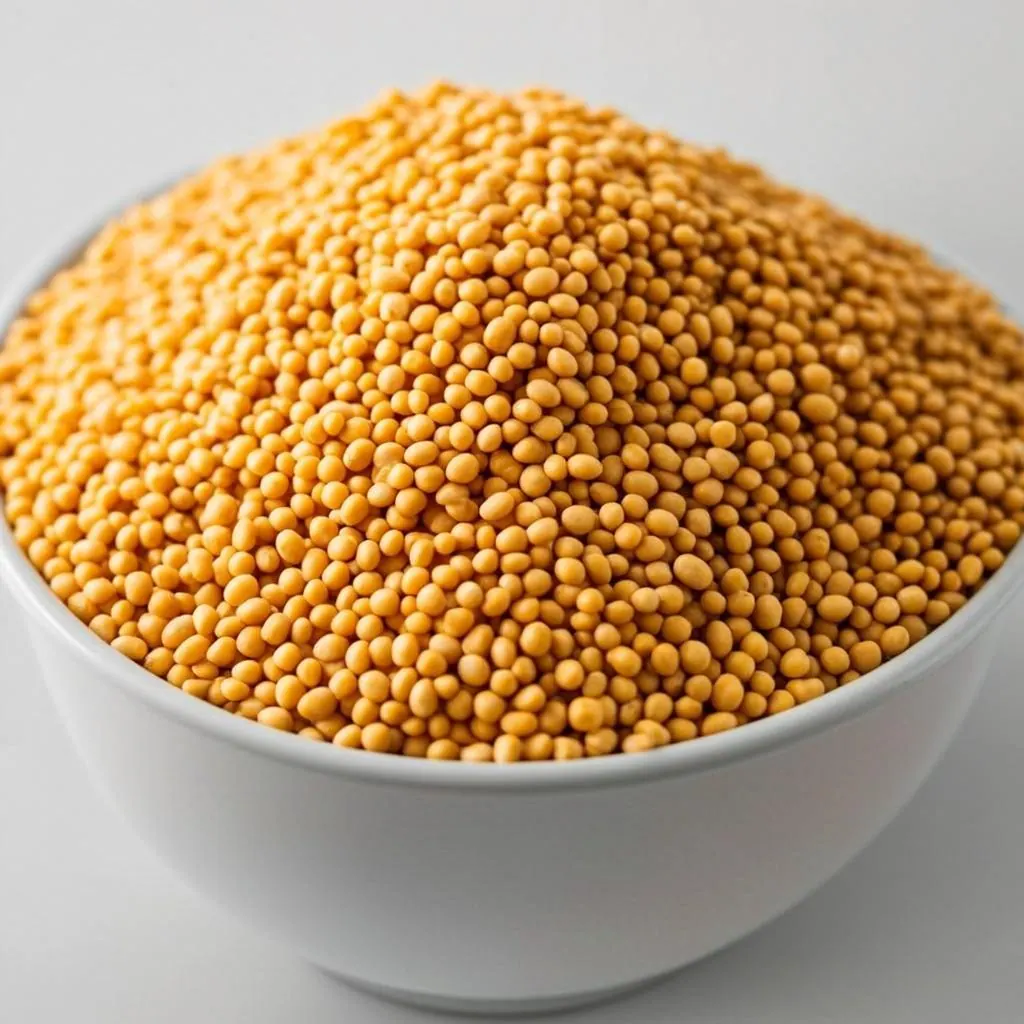
Green gram is the one Indian pulse where a substantial part of the export trade buys a living seed rather than a food ingredient. If the lot is going to be sprouted, whether for retail sprouts, for a food service kitchen or for a sprouted-flour process, then the only specification that really matters is germination percentage, and everything else on the certificate is secondary. If the lot is going to be cooked, germination is irrelevant and size and cleanliness lead.
Those are two different purchases from one commodity, and the contract has to say which one it is.
Whole green gram is graded on a sieve
Whole moong is graded by seed size, expressed as the sieve aperture the seed is retained on, in millimetres.
| Sieve grade | What it means | Usual destination |
|---|---|---|
| 4.0 mm and above | Largest, most uniform seed | Premium sprouting, premium retail |
| 3.5 mm and above | Large, good uniformity | Sprouting, retail packs |
| 3.0 mm and above | The volume grade | General retail, cooking, milling |
| 2.5 mm and above | Smaller seed | Milling into dal, industrial use |
| Below 2.5 mm | Small and mixed | Milling, feed, lower-value channels |
Two things about this that buyers get wrong. The size premium is a size premium, not a quality premium: a 3.0 mm lot can be cleaner, fresher and better in every respect than a 4.0 mm lot. Pay for size when size does something for you, which it does for sprouting and for retail appearance, and not otherwise.
And a single-figure grade says nothing about uniformity. "3.5 mm and above" allows everything from 3.5 mm to the largest seed in the crop. If uniformity matters, specify a band with an upper and a lower aperture, and a maximum percentage passing the lower sieve. This is the same reasoning applied to count-based grading in the kabuli chickpea guide, where a count range without a uniformity limit is only half a specification.
Germination: the specification most sprouting contracts omit
If the end use is sprouting, germination percentage is the product. Ninety percent minimum is the normal commercial expectation, ninety-five is achievable from good fresh material, and anything much below ninety produces a visibly poor sprout tray with unsprouted seed the consumer can see.
What kills germination:
- Heat. Drying at too high a temperature, or storage in a hot warehouse or a hot container, damages the embryo. This is the most common cause and the least visible.
- Fumigation. Some agents at some doses and exposures reduce or destroy germination. This is the second most common cause and it is entirely avoidable with planning.
- Age. Germination declines from harvest onwards, slowly under good storage and quickly under poor storage.
- Mechanical damage. Rough handling, aggressive cleaning and repeated conveying crack seed coats and injure embryos. Cracks are often invisible without a stain test.
- Moisture cycling. Wetting and re-drying, including in some cleaning processes, reduces viability.
The contractual response is more specific than "germination 90 percent minimum":
| Clause | Why |
|---|---|
| Germination percentage minimum, with the test method named | A figure without a method is not comparable between laboratories |
| Tested after any fumigation, not before | Otherwise the certificate describes seed that no longer exists |
| Tested on the shipped lot, with sampling by a named surveyor | A general sample of the supplier's material proves nothing about your container |
| Fumigation agent, dose and exposure agreed in advance and recorded | This is the avoidable failure |
| Container stowage and any temperature control stated | Heat in transit is real, particularly on a deck stow through the tropics |
| Whether the contractual figure is at load or on arrival | Germination declines in transit. Somebody carries that decline |
That last line is the one that turns into a dispute. Germination genuinely falls during a long warm voyage, so a figure tested at load and a figure tested on arrival will differ even when everyone has behaved correctly. Decide in advance which one governs and price accordingly.
The milled forms
| Form | Description | Cooking behaviour | Usual use |
|---|---|---|---|
| Moong chilka | Split with green skin attached | Holds shape better, more fibre | Textured dals, khichdi |
| Moong dhuli | Split and dehusked, yellow | Fastest cooking, breaks down readily | Everyday dal, halwa, batters |
| Mogar | Dehusked whole or lightly split yellow | Between the two | Snacks, namkeen, premium retail |
| Whole green | Unprocessed, skin intact | Slowest, needs soaking | Sprouting, whole-pulse dishes |
Dhuli moong is the fastest-cooking pulse in the everyday Indian range, which is an asset in the kitchen and a hazard in a specification. It disintegrates quickly, so a lot with high brokens gives a pasty result, and any admixture of a slower pulse is glaringly obvious because the intruder is still firm when the moong has gone.
Dehusked moong splits and dehusked urad splits look similar and differ mainly in shade, so admixture between them is easy to create at a mill running both and easy to miss on receipt. Specify a limit for it explicitly. The urad side is covered in the urad and black gram article.
The specification
| Parameter | Working range | Notes |
|---|---|---|
| Moisture | 10% to 12% maximum | Lower for sprouting lots, since heat plus moisture damages viability |
| Purity, sound seed or splits | 98% to 99.5% minimum | Higher end for premium sprouting and retail |
| Sieve grade | Stated in mm, with a band if uniformity matters | For whole seed |
| Germination | 90% minimum, method named | For sprouting lots only. Test after fumigation |
| Broken and split | 0.5% to 2% maximum | On whole seed, a split will not sprout, so tighten for sprouting |
| Foreign matter | 0.1% to 0.5% maximum | Stones, dust, extraneous seeds |
| Weevilled and insect damaged | 0.5% to 1% maximum | Damaged seed does not germinate |
| Damaged, shrivelled and immature | 1% to 2% maximum | Shrivelled seed sprouts poorly and looks bad in a pack |
| Admixture of other pulses | 0.5% maximum | Particularly urad on the dehusked splits |
| Crop year | Stated | Decisive for germination |
The point buried in that table: for a sprouting lot, every defect fraction is also a germination fraction. A broken seed does not sprout. A weevilled seed does not sprout. A shrivelled seed sprouts weakly. So a 98 percent purity lot with two percent damage has a ceiling on its germination before the embryo's own condition is even considered.
Microbiology, because sprouts are a recognised risk food
This is the part of a green gram contract that a food-safety-conscious buyer cares about most, and it belongs here rather than in a footnote. Sprouting takes a dry seed and holds it warm and wet for days, which is close to ideal for bacterial growth. Any pathogen present on the seed at low levels can multiply substantially during sprouting, and mung bean sprouts have a documented history in foodborne outbreaks internationally.
The consequences for a seed contract:
- Salmonella and pathogenic E. coli testing on the seed lot is a reasonable requirement for any lot sold for sprouting, and increasingly it is a customer requirement rather than an option.
- Sampling matters more than the method, for the same statistical reason it does with mycotoxins: contamination is heterogeneous and a small sample from a large lot is a weak measurement. The reasoning in the aflatoxin article applies directly.
- The seed cannot be sterilised without killing it, which is the whole difficulty. Steam, irradiation and ethylene oxide all defeat germination, so the microbial control has to be agricultural and hygienic rather than a kill step at the end. That makes the growing and handling history genuinely relevant, not just paperwork.
- Destination requirements for sprouting seed are stricter than for cooking pulses in several markets, and the importer usually carries specific obligations. Confirm the position for the destination before contracting.
Storage, fumigation and the sea leg
For cooking lots, standard pulse practice applies: 10 to 12 percent moisture, laminated woven bags on humid routes, and fumigation planned into the schedule rather than added at the end.
For sprouting lots, the fumigation decision is the whole game. It has to be agreed in advance, with the agent, dose and exposure recorded, and germination tested afterwards. A supplier who fumigates to a routine schedule and then presents a germination certificate dated before treatment has given you a document about a different lot. The documentary side, including what the phytosanitary certificate covers and what a treatment record has to show, is in the phytosanitary and fumigation article.
Heat in transit deserves a thought too. A container on an exposed stow through the tropics gets hot, and heat is the quiet germination killer. If viability is contractual and the value justifies it, discuss stowage.
How we supply it
We ship whole green gram and moong dal with the sieve grade stated in millimetres rather than as a grade name, and for sprouting lots we test germination after fumigation on the shipped lot with the fumigation agent and dose recorded on the documents. Crop year goes on the certificate of analysis, and pathogen testing with a defined sampling plan is standard on sprouting material.
The other milled pulses follow the same logic with their own functional parameters: urad and black gram, toor dal and chana dal.