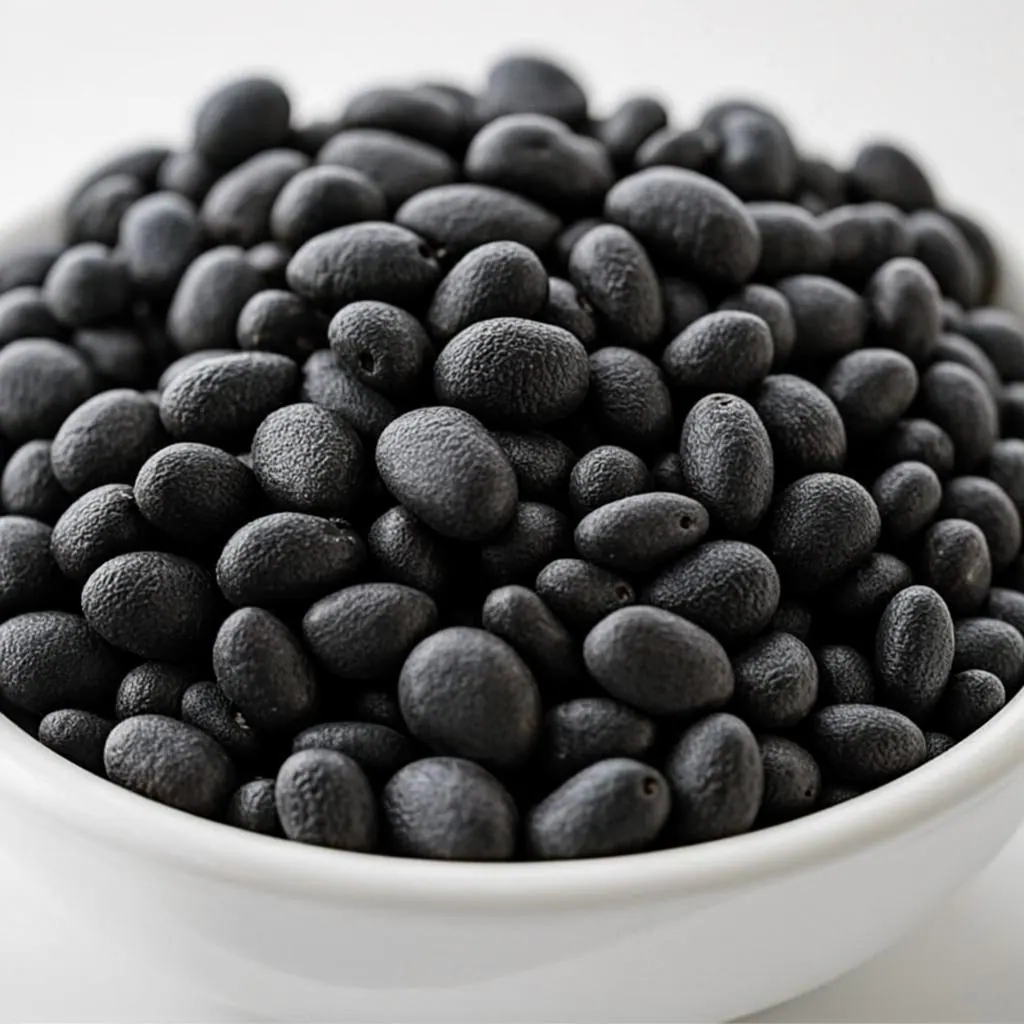
Urad is the pulse where the form matters more than in any other, because the same seed becomes four commercially distinct products depending on what the mill does to it. An enquiry for "urad dal" without specifying the form is genuinely ambiguous, and the four forms differ in price by a wide margin.
It is also the pulse where the parameter that decides customer satisfaction is absent from every standard specification. If your buyer is making idli batter, dosa batter or papad, they are buying a functional property, and a certificate of analysis showing 99 percent purity and 11 percent moisture tells them nothing about whether it will work.
The four forms
| Form | Indian name | Description | Typical use |
|---|---|---|---|
| Whole with skin | Sabut urad, urad whole | Small black seed, skin intact | Dal makhani, whole pulse dishes, onward milling |
| Split with skin | Urad chilka | Split cotyledons with black skin attached | Rustic dals, textured preparations |
| Split dehusked | Urad dhuli, urad washed | Creamy white splits, skin removed | Batter, vada, papad, general cooking |
| Whole dehusked | Urad gota | Whole round white kernel, skin removed | Idli and dosa batter, premium retail |
Gota is worth a note because it is often misunderstood outside India. It is not a whole black urad that has been polished pale. It is the whole kernel with the husk removed and the two cotyledons still joined, which requires a milling process that dehusks without splitting. That is harder than splitting, the yield is lower, and it is why gota carries a premium over dhuli.
The commercial mistake to avoid is treating dhuli and gota as interchangeable because both are white. Many batter makers specifically want gota, and a substitution will be noticed.
The functional parameter, and why it is not on the certificate
Urad's usefulness in fermented batter and in papad rests on a property none of the standard lines measure. The pulse contains a mucilaginous fraction, a combination of protein and polysaccharide, that gives a ground urad paste its characteristic slippery, cohesive body. In batter that fraction is what traps air during fermentation, giving idli its rise and texture. In papad it is what allows a very thin dough to be rolled and dried without cracking.
That fraction is not constant. It differs by variety, it declines as the pulse ages, and it can be affected by heat exposure during processing or storage. Which produces the following situation, which happens often: a lot passes every written line on the specification and fails at the customer's plant.
The fix is not another laboratory number. It is a performance trial written into the contract:
- Agree a method with your customer. For batter, a fixed soak time, a fixed grind, a fixed fermentation temperature and time, and a measured rise or a specific volume.
- Run it on the pre-shipment sample, not on a general sample of the supplier's material.
- Record the result and hold it with the sealed retained sample.
- Make acceptance conditional on the trial, not only on the analytical certificate.
This costs a few hundred rupees and a day. It is the single highest-value clause available in an urad contract, and almost nobody includes it.
Crop year, and why it bites harder here
All pulses develop a hard-to-cook character with age. Urad has a second age-related problem: the functional fraction degrades, so old urad can cook acceptably and still perform poorly in batter.
Ask for crop year on the certificate of analysis. Treat its absence as a question rather than an omission. And be sceptical of an unusually attractive price on dhuli or gota out of season, because the most common explanation is carryover stock, which looks identical and behaves differently.
Colour, and why dhuli is unforgiving
Dhuli urad is the whitest product in the everyday pulse range, and a white background shows every defect. Greyish splits, yellowed splits, splits with residual skin fragments and heat-damaged splits all stand out in a way they never would in chana dal or toor dal.
Two consequences. First, the sorting standard for dhuli has to be higher than for a coloured dal to reach the same perceived quality, which is part of why it costs more. Second, colour is not contractable in words. "White" is not enforceable, and natural crop-to-crop variation is real.
Use a sealed retained sample, one copy each side, drawn from the approved pre-shipment material. On a white product this resolves more disputes than any other single measure, because it converts an argument about adjectives into a comparison against a physical object.
The specification
| Parameter | Working range | Notes |
|---|---|---|
| Moisture | 10% to 12% maximum | The transit-critical line. Urad takes up ambient moisture readily |
| Sound splits or kernels | 97% to 99% minimum | Higher end for dhuli and gota where appearance leads |
| Broken and fragments | 1% to 3% maximum | For gota, any split counts as a defect, so state that explicitly |
| Husk and skin fragments | 0.2% to 0.5% maximum | Very visible on dhuli. Tighten if appearance matters |
| Foreign matter | 0.1% to 0.5% maximum | Stones, dust, extraneous seeds |
| Weevilled and insect damaged | 0.5% to 1% maximum | Bruchid damage is the usual finding |
| Discoloured and damaged | 1% to 2% maximum | On dhuli, this is the line buyers notice first |
| Admixture of other pulses | 0.5% maximum | Moong and urad splits are easy to confuse visually |
| Crop year | Stated | Functional performance depends on it |
| Colour | Against a retained sample | Not contractable in words |
That last point on gota deserves emphasis because it is a frequent oversight. If you order gota and the specification only limits "brokens", a lot with a high proportion of clean splits can technically comply while being the wrong product. Specify whole kernels as a minimum percentage.
Admixture with moong is worth a line of its own. Dehusked urad splits and dehusked moong splits are similar in size and shape and differ mainly in shade, so a mixed lot is easy to produce and easy to miss. If you buy both, receive them on separate days and check. The moong side of the equation is covered in the moong and green gram article.
Polish, and the same disclosure question
Urad dal, like toor, may be polished, and the same three routes exist: nothing, water, or an added oil. The consequences are identical, and the toor dal article works through them in detail. Two points specific to urad.
Because dhuli urad is white, oil polish has a more dramatic visual effect than on a coloured dal, so the commercial temptation to use it is stronger. And because urad is often bought for a fermented application, an oil film on the surface is not neutral: it can affect water uptake during soaking and it is an added ingredient in a product frequently sold as a single-ingredient food. If your customer is a batter or papad manufacturer, ask for unpolished and confirm it.
Storage, insects and the sea leg
Urad's affinity for moisture is a functional asset and a storage liability. On a humid destination, laminated woven bags rather than plain, and a warehouse humidity conversation with your customer, are both worth having.
Bruchid beetles are the routine insect risk in urad and they arrive with the crop rather than in the container, so infestation is a storage-history issue at origin. Fumigation timing belongs in the shipping plan rather than being bolted on at the last moment, and the documentary requirements differ by destination. The phytosanitary and fumigation article covers what the certificate has to say and what the treatment record has to show.
| Format | Sizes | Notes |
|---|---|---|
| PP woven bag, laminated | 25 kg, 50 kg | The default. Laminated for humid destinations |
| Jute bag | 25 kg, 50 kg | Required by some destinations. Declare food-grade batching oil |
| Bulk bag | 500 kg, 1,000 kg | Watch split damage in handling, especially for gota |
| Retail pack | 500 g to 5 kg | Specify film and whether nitrogen flushing is included |
Container weight-out behaviour differs between the whole and milled forms, and dehusked forms load denser than the same commodity with skin on. Use the break-even density method in the container loading guide rather than a rule of thumb.
The classification and policy point
The four forms do not all sit on the same tariff line, and Indian export policy conditions attach to the code rather than to the description you use in an email. Whole black gram and dehusked split black gram can be treated differently, and Indian pulse export policy has changed repeatedly over the last two decades.
Before contracting, verify the current policy condition for the specific ITC HS line against the DGFT schedule, and put a clause in the contract covering what happens if the position changes between order and shipment. The classification itself is covered in the HS code article.
How we supply it
We ship whole black gram and urad dal with the form named precisely, crop year on the certificate of analysis, and a sealed retained sample where colour or functional performance is commercially sensitive. Where a buyer's end use is batter or papad we will run an agreed trial on the pre-shipment sample rather than asking them to rely on the analytical certificate alone.
The other milled pulses are covered separately: toor dal, moong and green gram and chana dal.