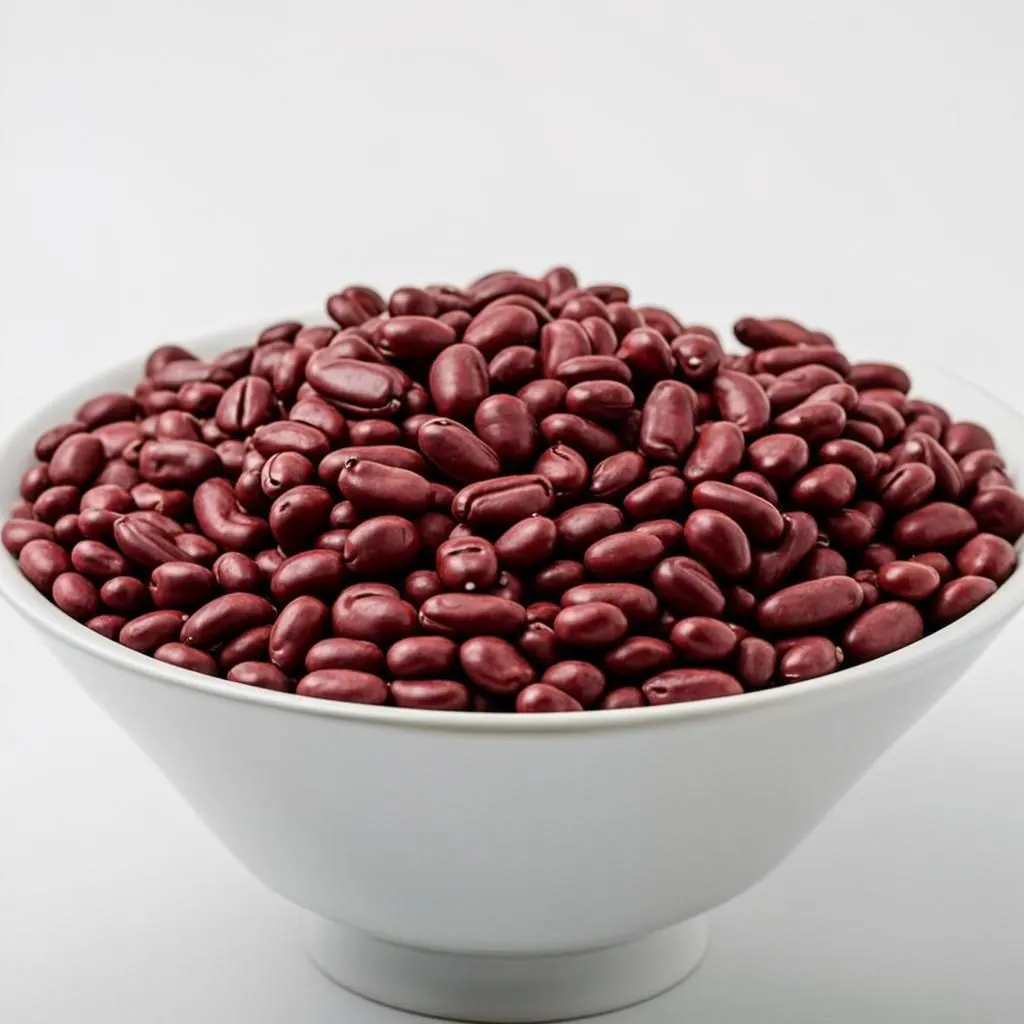
Kidney beans are the pulse where the same commodity serves two buyers with almost nothing in common. A retail packer wants a large, uniform, brightly coloured bean and cares about appearance in a transparent pack. A canner wants predictable hydration and a bean that does not split in the retort, and does not much care whether it is beautiful. Selling the same specification to both is how a supplier disappoints one of them.
There is also a genuine toxicology point in this commodity that most pulse articles skip over, and it belongs near the top rather than in a footnote, because it affects what your pack has to say.
The types
| Type | Indian name and origin | Appearance | Typical use |
|---|---|---|---|
| Light red kidney | Rajma, various regions | Medium to large, pinkish red | Curries, retail dry packs, canning |
| Dark red kidney | Rajma, Jammu and hill regions | Deep maroon red, glossy | Canning, chilli, salads, wet packs |
| White kidney | Safed rajma | Large, cream to white | Soups, salads, cannellini-style uses |
| Speckled and Chitra | Chitra rajma, hill regions | Cream with maroon mottling | Retail appeal, regional Indian dishes |
| Jammu rajma, small red | Jammu and Kashmir | Small, dense, deep colour | Premium regional retail, reputation buying |
Jammu rajma deserves a note because it is bought on reputation as much as on specification. It is smaller than the commodity red kidney bean, denser, and it is prized for flavour and texture in Indian domestic and diaspora markets. It carries a premium that a count-based specification cannot explain, which means two things: verify origin if you are paying the premium, and do not compare its price against a commodity kidney bean and conclude you are being overcharged.
Counts, and what a count does not tell you
Kidney beans are sized by seed count per 100 grams, so a lower count is a larger bean. The arithmetic is worth doing yourself, because it is the same trick that works on kabuli chickpeas: average seed weight in grams is 100 divided by the count.
| Count per 100 g | Average seed weight | Character |
|---|---|---|
| 90 to 110 | 0.91 g to 1.11 g | Large. Premium retail, visual impact |
| 110 to 130 | 0.77 g to 0.91 g | Large commercial grade |
| 130 to 160 | 0.63 g to 0.77 g | The volume grade for most uses |
| 160 to 200 | 0.50 g to 0.63 g | Smaller. Canning, curries, blends |
| Above 200 | Below 0.50 g | Small types, including Jammu rajma |
What a count band does not fix is uniformity. "130 to 160" allows a lot that is mostly 155 with a scattering of 132, and that lot will cook unevenly and look inconsistent in a pack. If uniformity matters, add a limit on the percentage outside the band, and ask for a sieve analysis rather than a single average. The same logic is worked through for chickpeas in the kabuli size and count guide.
The lectin point, stated properly
Kidney beans contain phytohaemagglutinin, a lectin concentrated in the raw seed, and red kidney beans carry the highest levels among common beans. Consuming raw or inadequately cooked beans causes acute nausea, vomiting and diarrhoea, typically within a few hours. It is not a chronic hazard and it is not a contamination issue. It is a property of the bean, and it is destroyed by adequate heat.
Three practical consequences for anyone shipping or packing kidney beans.
The cooking instruction is a control measure. Soaking followed by vigorous boiling is what inactivates the lectin. A retail pack of dry kidney beans should carry a clear instruction to that effect, and in several markets that instruction is effectively expected rather than optional. Check the destination's labelling requirement rather than copying an instruction from another product.
Slow cooking without a prior boil is the specific practice to warn against. Temperatures below boiling, held for a long time, can leave lectin activity substantially intact, which is why the classic advice is to boil first and only then transfer to a slow cooker. If your pack copy says "simmer gently until tender" and nothing else, it is inadequate.
Canned and pre-cooked product is not affected, because the retort process comfortably exceeds what is needed. This is worth knowing because it means the hazard sits with dry-bean retail and food service, not with your canning customer.
State this plainly on your specification sheet and in your customer documentation. It is a point of professional credibility rather than a liability, and a buyer who has not thought about it will be glad you did.
What a canner actually buys
If your customer cans, retorts or pre-cooks, appearance is secondary and these are the specifications that decide whether the lot performs.
| Parameter | What it means | Working expectation |
|---|---|---|
| Hydration coefficient | Soaked weight divided by dry weight | About 1.8 to 2.0 |
| Splits after cooking | Percentage of beans split or burst after a defined cook | As low as possible, contract a maximum |
| Washed drained weight | Weight of beans after draining a finished can | Set by the customer's fill standard |
| Hard shell and hard-to-cook | Beans that fail to hydrate in the soak | Contract a maximum, usually low single digits |
| Size uniformity | Spread within the count band | Tighter than a retail lot needs |
| Colour bleed | Pigment released into the brine | Test on the approved sample |
The hydration coefficient is the number to start with, because it links directly to the canner's economics. If a bean takes up less water than expected, the drained weight in the can falls short and the line has to compensate with more beans per can, which is a direct cost. If it takes up more, the beans over-soften in the retort and split.
The trial to ask for is simple: a defined soak time in defined water at a defined temperature, a weight before and after, then a defined cook and a count of splits. Run it on the pre-shipment sample, record the result, and hold it with the sealed retained sample. This is the same principle as the batter trial for urad described in the urad and black gram article: where the value is functional, the contract needs a functional test.
The hard-to-cook defect and why crop year matters
Kidney beans develop a hard-to-cook character with age, and it is accelerated by storage at high temperature and high humidity, which describes a large part of the Indian storage year. The mechanism involves changes in the seed coat and in the pectin of the cotyledon that make water uptake and softening progressively harder.
The problem for a contract is that it is invisible. A hard-to-cook lot can be clean, bright, correctly sized, correctly moisture-tested and completely sound, and still refuse to soften after an hour of boiling. Nothing on a standard certificate predicts it.
The two defences are cheap. Ask for crop year on the certificate of analysis and treat its absence as a question. And run a cook trial on the pre-shipment sample with an agreed time and an agreed acceptance, exactly as a canner would. An unusually attractive price out of season on a large-count premium bean is most often carryover stock, which looks identical and behaves differently.
The specification
| Parameter | Working range | Notes |
|---|---|---|
| Moisture | 12% to 14% maximum | Beans tolerate slightly higher than milled dals, but watch the sea leg |
| Purity, sound beans | 98% to 99.5% minimum | Higher end for premium retail |
| Count per 100 g | Stated as a band | Add an out-of-band limit if uniformity matters |
| Broken and split | 0.5% to 2% maximum | Splits look poor in a transparent pack and cook unevenly |
| Foreign matter | 0.1% to 0.5% maximum | Stones are the usual finding in beans |
| Weevilled and insect damaged | 0.5% to 1% maximum | Bruchid damage, also a storage-history indicator |
| Discoloured and off-colour | 1% to 2% maximum | Very visible on a coloured bean |
| Wrinkled and shrivelled | 1% to 2% maximum | Hydrates poorly, looks poor |
| Admixture of other classes | 0.5% maximum | Mixed light and dark red is a common complaint |
| Crop year | Stated | The best predictor of cooking behaviour |
| Colour | Against a retained sample | Type names cover a real range |
Stones deserve a specific line. Beans are grown and harvested in conditions where small stones of similar size and density to the bean are common, and gravity separation is imperfect on a product this size. A destoner and an optical sorter both help, and it is reasonable to ask what equipment the lot actually passed through rather than accepting a foreign matter percentage alone. A single stone in a retail pack generates a customer complaint that no certificate prevents.
Packing, storage and loading
| Format | Sizes | Notes |
|---|---|---|
| PP woven bag, laminated | 25 kg, 50 kg | The default. Laminated on humid destinations |
| Jute bag | 25 kg, 50 kg | Required by some destinations. Declare food-grade batching oil |
| Bulk bag | 500 kg, 1,000 kg | Watch seed coat damage in repeated handling |
| Retail pack | 500 g to 2 kg | Transparent film shows off colour and shows off every defect |
Beans are a low-density pulse relative to milled dals, so a container is more likely to cube out than to weigh out, and the trade-off between bag size and payload is real. Work it out with the break-even density method in the container loading guide rather than assuming a tonnage.
Storage temperature is not just a spoilage question here, it is a quality question, because heat accelerates the hard-to-cook defect. A lot stored cool arrives more cookable than the same lot stored hot, and neither certificate will say so. If you are buying repeatedly from one supplier, asking about warehouse conditions is a more useful question than most of the ones on a standard audit form.
Bruchid beetles are the routine insect risk and they arrive with the crop, so fumigation belongs in the shipping schedule rather than as an afterthought. The documentary requirements are covered in the phytosanitary and fumigation article.
How we supply it
We ship kidney beans against a named type and a count band with an out-of-band limit rather than a single average, with crop year on the certificate of analysis and a sealed retained sample for colour. Where the buyer cans or pre-cooks, we run an agreed hydration and split trial on the pre-shipment sample instead of asking them to infer performance from a cleanliness certificate.
The other whole pulses are covered separately: cowpeas and moth beans and dry yellow and green peas.