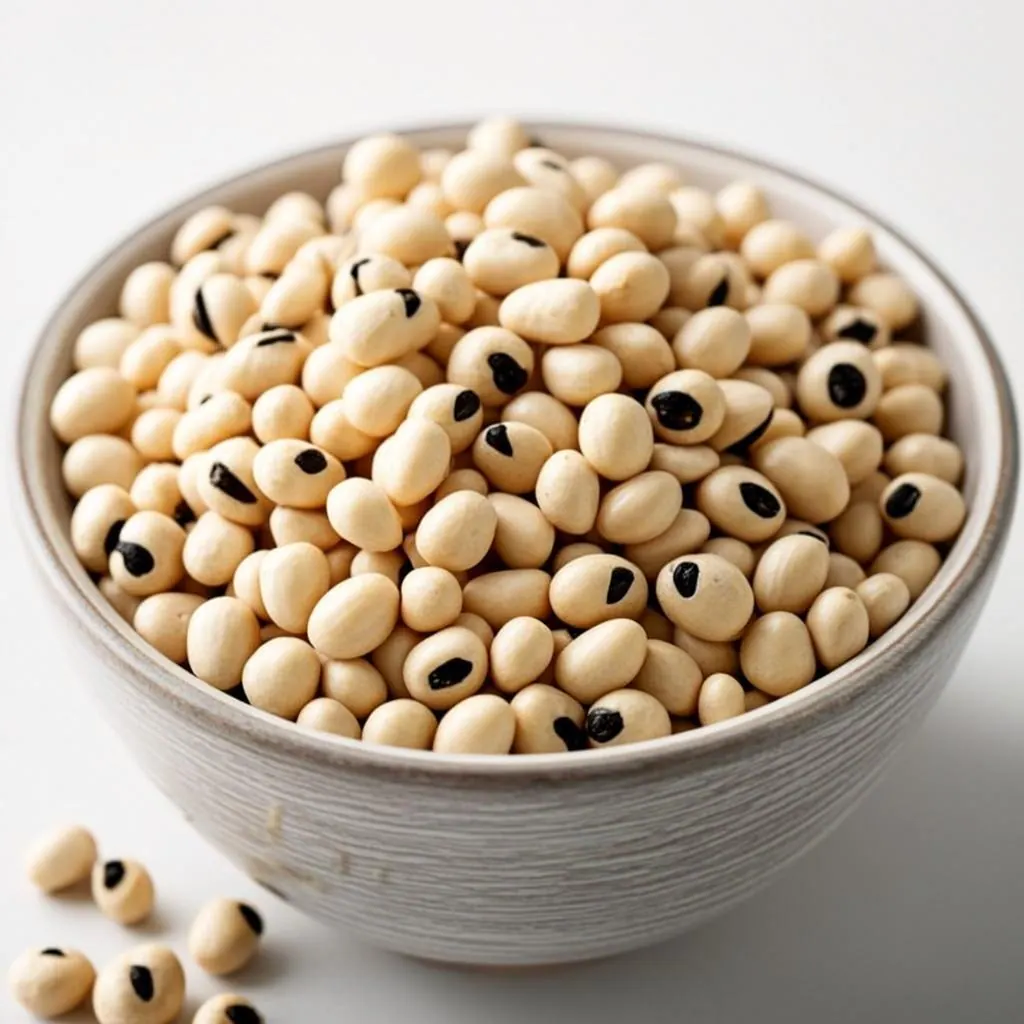
These two pulses get grouped together in offers and in shipping, and they should not be grouped together in a specification, because their buyers want completely different things. Cowpea is usually bought for appearance and cooking, and its quality is decided by the seed coat. Moth bean is usually bought either as a living seed for sprouting or as a flour feedstock for the snack industry, and its quality is decided by viability or by frying behaviour.
Both are small, both are commodity-priced, and both are cleaned with more difficulty than their price suggests.
Cowpea classes
| Class | Indian name | Appearance | Usual market |
|---|---|---|---|
| Black-eyed | Lobia, chawli | Cream seed with a dark eye around the hilum | International retail, canning, salads |
| Red and brown | Red lobia | Uniform reddish brown | Indian and African markets, curries |
| White and cream | Safed lobia | Uniform pale, no eye or a faint one | Retail, blends, purees |
| Speckled and mottled | Regional selections | Mixed patterning | Regional and speciality trade |
Not every cowpea is a black-eyed pea, which sounds obvious and causes real confusion in enquiries. If your customer wants the classic cream seed with a defined dark eye, the contract has to say black-eyed class rather than cowpea, because a red cowpea lot will honestly satisfy the word "cowpea" and disappoint everybody.
For the black-eyed class specifically, the eye is part of the specification. Buyers judge it on definition and on whether the pigment has bled into the surrounding seed coat. A crisp, well-defined eye on a clean cream background is what a premium lot looks like. Bleeding, blurred or faded eyes, or a background that has gone dull or grey, all pull the lot down even though nothing else is wrong. Because that is a visual judgement, it belongs on a sealed retained sample rather than in adjectives.
The seed coat is the whole story in cowpea
Cowpea's seed coat is thin relative to a kidney bean's, and it cracks. Cracking happens at harvest, in threshing, in aggressive cleaning, in repeated conveying and in handling at moisture levels that make the seed brittle.
Why it matters more than the crack itself suggests:
- A cracked seed discolours around the crack, so today's invisible crack is next month's visible defect.
- Cracked seed absorbs water unevenly, so it cooks unevenly and can burst while sound seed is still firm.
- In a wet pack or a can, cracked seed loses solids into the liquid and looks poor.
- Cracks are entry points for insects and for mould, so a cracked lot has a shorter practical life.
The problem is that cracks are hard to see in bulk. A visual inspection of a bag misses them, and a general purity figure does not cover them. So ask for a cracked and split seed coat maximum as its own line, and ask how it was assessed. A defined visual count on a defined sample size is reasonable, and for a canner it is worth combining with a soak test, since cracked seed reveals itself immediately in water.
The corollary is a handling question worth raising with the supplier: over-dried cowpea cracks more. A lot dried to the bottom of the moisture range for safety may be more brittle and crack more in handling, which is a genuine trade-off rather than a fault. Discussing where in the range they aim is a more useful conversation than insisting on the lowest possible number.
Moth bean, and its two very different buyers
Moth bean, matki or dew gram, is a tiny drought-tolerant pulse grown mainly in Rajasthan, Gujarat and adjoining dry regions. It has two real export demand streams and they want opposite things.
The sprouting buyer is buying a living seed. Germination percentage is the specification and everything else is secondary. Ninety percent minimum is a reasonable expectation from fresh material, and the practical hazards are exactly the ones described for green gram: heat, fumigation, age, mechanical damage and moisture cycling. The clause structure is the same, and the moong and green gram article sets it out in full, including why the germination test has to be run after fumigation rather than before, and why every defect fraction is also a germination fraction.
One extra point for moth bean specifically. It is a very small seed, so mechanical damage during cleaning is proportionally more likely, and a cracked or chipped seed will not sprout. If viability is contractual, the cleaning line matters as much as the storage.
The snack flour buyer is buying frying behaviour. Dehusked moth dal, ground, is the base of a large Indian fried-snack industry, and the flour's performance in a fryer, how it extrudes, how it holds together, how it colours and how crisp it stays, is the product. None of that appears on a pulse specification.
| What the snack buyer actually needs | Why a standard specification misses it |
|---|---|
| Particle size distribution, not just a mesh number | Two flours at the same nominal mesh extrude differently |
| Freshness, by production date | The fat fraction oxidises and the flavour goes off in the fryer |
| Consistent dehusking | Residual husk shows as dark specks in a pale snack |
| Batch-to-batch consistency | A fryer line is set up once and does not want to be retuned |
| Oil uptake behaviour | Directly affects cost per unit and product texture |
The advice is the same as for urad in batter and kidney beans in the retort: where the value is functional, write a functional trial into the contract. Agree a method, run it on the pre-shipment sample, record the result and hold it with the sealed sample. The urad and black gram article explains why this clause is worth more than another analytical line.
The monsoon point
Moth bean is a dryland crop, which is precisely why it is grown where it is grown. That makes its availability and its quality unusually sensitive to the monsoon in western India. A poor rainfall year gives smaller, more shrivelled seed and a shorter, tighter market, and a good year gives plumper seed and easier buying.
Two practical consequences. Fresh-crop timing matters more than in an irrigated pulse, so ask about the crop and the region rather than only about the specification. And an unusually cheap offer in a poor year is worth a second look, because the most likely explanation is carryover stock or a small-seed lot, both of which look acceptable and perform differently. For sprouting, carryover stock is the specific risk, since germination is the first thing age takes.
Small seed makes cleaning harder
This applies to both pulses and it is the practical reason to look past the foreign matter percentage.
Mechanical cleaning separates on size, shape and density. A stone or a mud ball that is close in size and density to a large kidney bean is comparatively easy to reject. One that is close in size and density to a cowpea or a moth bean is much harder, because the separation windows overlap. Mud balls are the worst case, since they are similar in density to the seed and similar in colour to a brown one.
So for these commodities:
- Ask what the lot actually passed through. Gravity destoner, then optical or colour sorter, is the combination that works.
- Ask whether the optical sorter was set for stones and mud as well as for discoloured seed, since those are different settings.
- Treat a very low foreign matter figure from a lot that saw only mechanical cleaning with mild scepticism, and a moderate figure from a lot that saw an optical sorter as the better outcome.
A single stone in a retail pack costs a customer complaint, and on a small pulse it is the defect most likely to survive the line.
The specification
| Parameter | Cowpea | Moth bean |
|---|---|---|
| Moisture | 12% to 14% maximum | 10% to 12% maximum |
| Purity, sound seed | 98% to 99.5% minimum | 98% to 99% minimum |
| Cracked and split seed coat | Own line, low single digits | Own line, tighter if for sprouting |
| Eye definition and bleed | Against a retained sample, black-eyed class | Not applicable |
| Germination | Only if sold as seed | 90% minimum if for sprouting, tested after fumigation |
| Foreign matter | 0.1% to 0.5% maximum | 0.1% to 0.5% maximum |
| Stones and mud balls | Own line, given the size problem | Own line |
| Weevilled and insect damaged | 0.5% to 1% maximum | 0.5% to 1% maximum |
| Discoloured and stained | 1% to 2% maximum | 1% to 2% maximum |
| Shrivelled and immature | 1% to 2% maximum | Tighter in a poor monsoon year |
| Admixture of other pulses | 0.5% maximum | 0.5% maximum, moong is the confusion |
| Crop year | Stated | Stated, decisive for germination |
Moth bean and small moong can be confused visually in a mixed lot, which is why the admixture line is worth writing rather than assuming. And for cowpea, note that the cracked seed coat line and the discoloured line are related, since cracks become discolouration over time, so a lot with acceptable colour and high cracking today is a lot with poor colour on arrival.
Packing, storage and loading
| Format | Sizes | Notes |
|---|---|---|
| PP woven bag, laminated | 25 kg, 50 kg | The default. Laminated on humid destinations |
| Jute bag | 25 kg, 50 kg | Required by some destinations. Declare food-grade batching oil |
| Bulk bag | 500 kg, 1,000 kg | Handling damage is a real cost on thin-coated cowpea |
| Retail pack | 500 g to 2 kg | Transparent film shows the eye and shows every crack |
Both pulses carry the usual bruchid risk, arriving with the crop rather than in the container, so fumigation belongs in the shipping schedule. For a sprouting moth bean lot, that fumigation decision is the single most consequential one in the shipment, and it has to be agreed in advance with the agent and dose recorded and germination tested afterwards. The documentary side is in the phytosanitary and fumigation article.
Small pulses pack denser than large beans, so a container of cowpea or moth bean behaves differently from a container of kidney beans in the same bags. Work it through with the break-even density method in the container loading guide.
How we supply it
We ship cowpeas, moth beans and moth dal with the class named, a cracked seed coat limit stated as its own line, and stones and mud balls contracted separately from general foreign matter. For sprouting lots we test germination after fumigation on the shipped lot with the treatment and dose recorded, and for snack flour buyers we will run an agreed trial rather than asking them to infer frying behaviour from an analytical certificate.
The other whole pulses are covered separately: kidney beans, dry yellow and green peas and green gram.