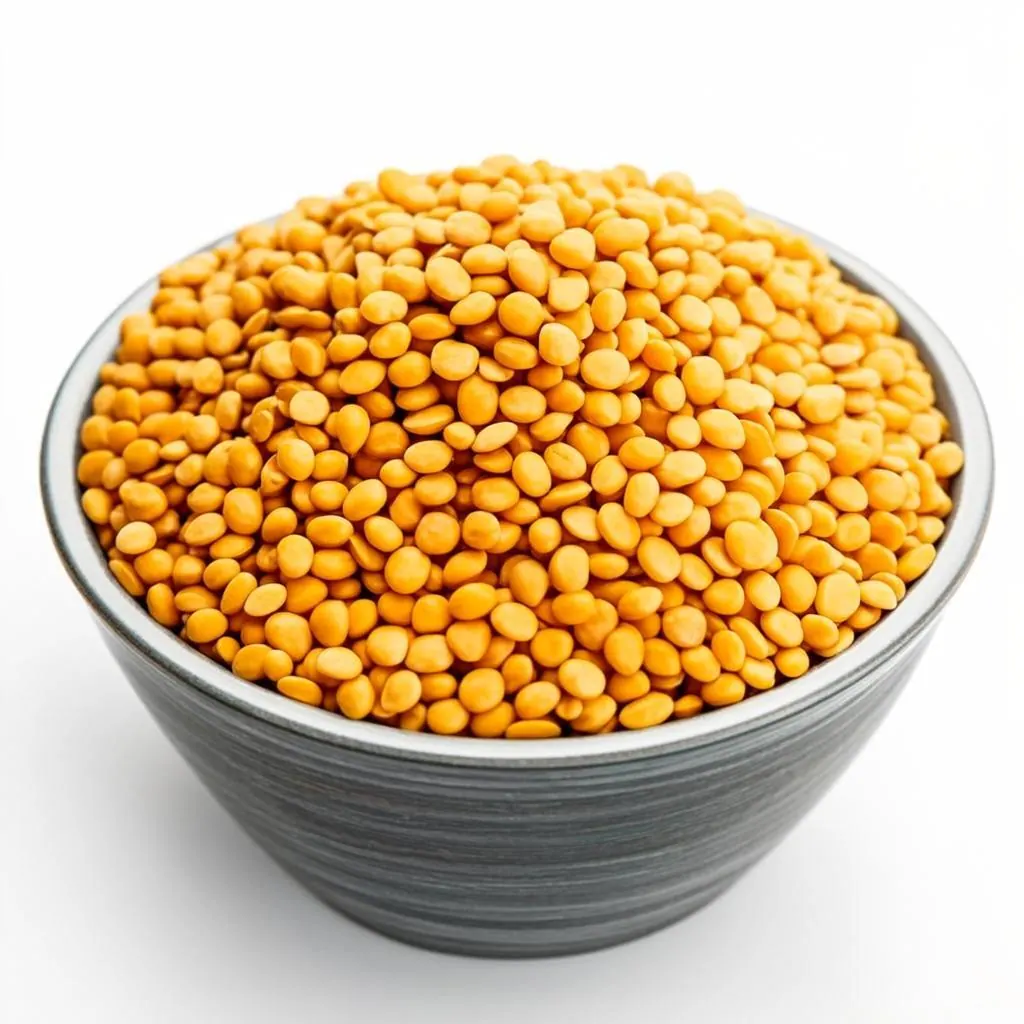
Yellow and green dry peas are the same species, Pisum sativum, grown as different market classes, and they share most of a specification. The interesting differences are three: green peas can lose their colour and yellow peas cannot, split peas invert the meaning of a defect, and the origin of a pea moving through India is a genuine question rather than a formality.
Bleaching, the defect that only exists in green peas
A green pea is sold on being green. The pigment in the seed coat and cotyledon fades with exposure to light, heat and time, moving the seed towards yellow or cream. A faded seed is described in the trade as bleached, and the bleach percentage is a graded line on a green pea specification in a way it never appears on a yellow pea one.
Bleaching does not change nutrition and it does not change cooking behaviour. It changes the only attribute a green pea buyer is paying extra for, which makes it commercially serious even though it is technically cosmetic.
| Factor | Effect | Practical control |
|---|---|---|
| Time from harvest | Steady fade | Buy fresh crop, and get crop year on the certificate |
| Light exposure | The fastest driver | Opaque packing, and warehouse practice at both ends |
| Heat | Accelerates the fade | Cool storage, and think about container stowage |
| Moisture cycling | Adds patchiness and dullness | Contract moisture, control drying |
| Field weathering before harvest | Bleaching that arrived with the crop | Ask about harvest conditions in the growing season |
The contractual answer is the same one that works for chilli colour: name the measurement point. A bleach maximum tested at load port on a sample drawn by the nominated surveyor is enforceable, and a bleach maximum with no point of measurement is an argument in waiting, because the lot will genuinely be more bleached on arrival than at dispatch. The reasoning is set out in more detail in the ASTA colour value article, which deals with the same category of problem in a different commodity.
If your green pea goes into a product where it is visible, buy above your target and keep your own record of what arrives, so that after a few shipments you have a fade curve for your own supply chain rather than a supplier's assurance.
Whole and split, and the inverted defect
| Form | Description | Cooking | Usual use |
|---|---|---|---|
| Whole yellow pea | Intact seed, seed coat on | Slow, needs soaking | Milling, protein extraction, snacks, feed |
| Whole green pea | Intact seed, seed coat on | Slow, needs soaking | Retail, snacks, wasabi and coated peas, canning |
| Split yellow pea | Dehusked, split cotyledons | Fast | Dal, soups, besan-style flours |
| Split green pea | Dehusked, split cotyledons | Fast | Soups, purees, retail |
| Pea flour | Ground split pea | Not applicable | Bakery, snack, batter, extenders |
The point that catches people out is that a split is a defect in a whole-pea contract and the product in a split-pea contract. That means the same physical fraction of a mill's output is worth very different money depending on where it is sold, and it creates an incentive at the margin. If you are buying whole peas, contract a split maximum explicitly rather than relying on a general purity figure, because a "98 percent sound" lot can carry a lot of splits and still be described honestly.
For whole peas, sizing is by sieve aperture, and as with green gram a single-figure grade allows a wide spread. If uniformity matters, specify a band and a maximum percentage passing the lower sieve. The reasoning is in the moong and green gram article.
The substitution problem, from both sides
Split yellow peas are similar in colour and size to chana dal and they are usually appreciably cheaper. That price gap is the whole reason yellow pea admixture is the most commonly reported substitution in the Indian split pulse trade.
If you are buying chana dal, the defences are an explicit yellow pea admixture limit and a sealed retained sample, which the chana dal article sets out.
If you are buying yellow peas, the same fact works in your favour and is worth understanding. You are buying a legitimate, useful, well-priced pulse in its own right, and there is nothing second-rate about it. Split yellow pea is an excellent soup and dal ingredient, it is the base of a large snack industry, and it is the feedstock of the pea protein business. The only thing to insist on is that it is sold as what it is, on its own specification, with its own name on the documents.
Pea protein, and the specification a food buyer never asks for
Yellow pea has become an industrial feedstock as much as a food pulse, because it fractionates well into protein, starch and fibre. That buyer wants a different specification.
| Parameter | Why the fractionation buyer cares |
|---|---|
| Protein content, on a stated moisture basis | It is the yield of the primary product |
| Starch content | The co-product, and it carries the process economics |
| Seed coat percentage carried through | Fibre in the wrong stream, and colour in the protein |
| Foreign material, tighter than food grade | Contaminants concentrate in a fractionation process |
| Variety consistency | Protein content is varietal as well as agronomic |
| Colour and appearance | Largely irrelevant, since the process destroys them |
Two things follow. Protein content must be quoted on a stated moisture basis, because a figure without one can be moved by a percentage point through drying alone and the comparison between two offers becomes meaningless. And if you are a food buyer competing with the protein industry for the same crop, expect the price behaviour of yellow pea to be driven by demand you cannot see in the food trade.
The origin question, stated honestly
India is one of the world's largest importers of yellow peas as well as a producer and exporter of processed pulse products. A substantial share of the yellow pea moving through Indian trade was grown elsewhere, commonly Canada or Russia, and then cleaned, graded, split or ground in India.
There is nothing improper about that. Processing is real value addition and it is a legitimate business. But it has consequences you should get in front of.
- Ask where the pea was grown and where it was processed, as two separate questions, because the answers can differ.
- Check what your market requires the certificate of origin to state. Rules on whether processing confers origin vary, and a preferential tariff claim in particular usually has specific origin criteria that cleaning and splitting may or may not satisfy.
- Traceability follows the growing origin, not the processing origin, for residues and for growing-season conditions. A pesticide question about a Canadian-grown pea is answered by Canadian agronomy, whatever the processing country.
- Indian export policy on pulses has changed repeatedly, so check the current condition for the specific ITC HS line against the DGFT schedule before contracting, and put a clause in the contract covering a policy change between order and shipment.
A supplier who answers the origin question directly is telling you something useful about how they operate. One who treats it as an awkward question is telling you something too.
The specification
| Parameter | Working range | Notes |
|---|---|---|
| Moisture | 12% to 14% maximum for whole, 10% to 12% for split | Split peas behave like a milled dal |
| Purity, sound seed | 98% to 99.5% minimum | Higher end for retail and for green peas |
| Sieve grade | Stated in mm, band if uniformity matters | Whole peas |
| Split and broken | 0.5% to 2% maximum in whole peas | Contract it separately from general purity |
| Bleached | Percentage maximum, green peas only | Name the measurement point and date |
| Foreign matter | 0.1% to 0.5% maximum | Stones and extraneous seeds |
| Weevilled and insect damaged | 0.5% to 1% maximum | Bruchid damage |
| Wrinkled, shrivelled and immature | 1% to 2% maximum | Hydrates poorly and looks poor |
| Earth-tainted and stained | 0.5% to 1% maximum | Field weathering signature |
| Admixture of other classes | 0.5% maximum | Yellow in green and green in yellow, both noticed |
| Crop year | Stated | Predicts bleaching and cooking behaviour |
| Colour | Against a retained sample | Especially for green |
Class admixture is worth a specific limit in both directions. A handful of yellow seeds in a green pea pack is immediately visible and reads as carelessness, and green in yellow reads the same way. It costs nothing to write the limit in and it prevents a complaint that has nothing to do with quality.
Packing, storage and loading
| Format | Sizes | Notes |
|---|---|---|
| PP woven bag, laminated | 25 kg, 50 kg | The default. Laminated on humid destinations |
| Jute bag | 25 kg, 50 kg | Required by some destinations. Declare food-grade batching oil |
| Bulk bag | 500 kg, 1,000 kg | Common for industrial and fractionation buyers |
| Retail pack | 500 g to 2 kg | For green peas, consider the light barrier against bleaching |
For green peas specifically, packaging is a quality control rather than just a container. A transparent retail film in a brightly lit store will fade the product on the shelf, which is a fade the exporter gets blamed for and cannot prevent. If the pack has to be transparent, discuss it openly with your customer and set expectations about shelf life under light.
Whole peas are a low-density pulse and split peas are denser, so the same container behaves differently with the two forms. Use the break-even density method in the container loading guide rather than a fixed tonnage.
How we supply it
We ship dry yellow peas, dry green peas, yellow pea dal and green pea dal with the growing origin and the processing origin both stated on the documents, a split maximum contracted separately from purity, and for green peas a bleach maximum measured at load and dated.
The other whole pulses are covered separately: kidney beans and cowpeas and moth beans. If your interest is the split pulse most often confused with yellow pea, start with the chana dal article.